Advertisements
Advertisements
प्रश्न
Use the option to fill in the blank.
Her frock______too long.
पर्याय
was
were
Advertisements
उत्तर
Her frock was too long.
APPEARS IN
संबंधित प्रश्न
In the following items, sentence A is complete, while sentence B is not. Complete sentence B, making it as similar as possible to sentence A. Write sentence B.
(A) He is forgetful as well as careless with his work.
(B) Besides .............................................................................
Explain, ‘Just a palsied few at the windows set;’
The air broke into a mist with bells,
The old walls rocked with the crowd and cries.
Had I said, "Good folk, mere noise repels....
But give me your sun from yonder skies!"
They had answered "And afterward, what else?"
Read the above lines and answer the question that follow.
Explain“And afterward, what else?”
Discuss with reference to the story An Angel in Disguise how love has the power to transform.
Fill in the blank with an appropriate word:
The poet's mother was stung __________ a scorpion.
Read the extract given below and answer the questions that follow:
The morning stretched calm, beautiful, and warm.
Sprawling half-clad, I gazed out at the form
Of shimmering leaves and shadows. Suddenly
A strong flash, then another, startled me.
I saw the old stone lantern brightly lit.
(A Doctor’s Journal Entry for August 6, 1945: Vikram Seth)
(i) In which country did the incident described in the poem occur? What had caused the flashes? What happened to his home soon after?
(ii) Describe the injuries suffered by the Doctor.
(iii) What was his wife’s name? What happened to a house standing before them?
(iv) How does he describe the people he met on the way?
(v) Why were the people walking with their hands away from their bodies? What was common to all of them? What message does the poem convey?
We have had to respect for nature. Now we are suffering from the effects of global warming.
Discuss the following with your partner and complete the following sentence.
Before eating apples brought from the market, I wash and peel them off ____________________.
You might have learned about organic farming. Make groups and discuss the difference between conventional farming and organic farming and write it down.
| Sr.No. | Conventional Farming | Organic Farming |
| 1. | ||
| 2. | ||
| 3. |
Divide the class into groups of 4-6. Each group selects for itself, one of the difficult situations listed below. Each group imagines itself to be in that situation.

(a) marooned on an island
A group of passengers is marooned on an island in the middle of the ocean.
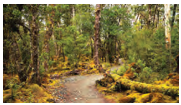
(b) lost in a forest
A group of pilgrims walking through a thick jungle have lost their way.

(c) stranded on the highway
A team of players from an office has got down at the wrong place on a highway at night. It is a lonely spot.
- Describe their surroundings in 4-5 sentences.
- Write the reactions of the companions using exclamations.
- Using your imagination, write what is the only ray of hope for them.
- Two members of the group are going out to try to get help. They can take any five things with them. Write what they choose, and why they choose it.
The same landscape appears different at different times. What message can we draw from this?
‘..... and that’s how I realized that courage and hope can help me overcome any major mishap/problem in life.’ Write an episode/experience from your own life that leads to the above conclusion.
What is the meaning of ‘intellectual rubbish’?
Write an autobiography of a hundred-rupee note. (8-10 lines.)
Discuss in groups. Draw the haunted house described in the poem and write a paragraph about it in your own words.
I can do the sum ________. [easy}
How is school education in the village different from that in the city?
Summarizing is to briefly sum up the various points from the notes made from the below passage.
The Sherpas were nomadic people who first migrated from Tibet approximately 600 years ago, through the Nangpa La pass and settled in the Solukhumbu District, Nepal. These nomadic people then gradually moved westward along salt trade routes. During 14th century, Sherpa ancestors migrated from Kham. The group of people from the Kham region, east of Tibet, was called “Shyar Khamba”. The inhabitants of Shyar Khamba, were called Sherpa. Sherpa migrants travelled through Ü and Tsang, before crossing the Himalayas. According to Sherpa oral history, four groups migrated out of Solukhumbu at different times, giving rise to the four fundamental Sherpa clans: Minyagpa, Thimmi, Sertawa and Chawa. These four groups have since split into the more than 20 different clans that exist today.
Sherpas had little contact with the world beyond the mountains and they spoke their own language. AngDawa, a 76-year-old former mountaineer recalled “My first expedition was to Makalu [the world’s fifth highest mountain] with Sir Edmund Hillary’’. We were not allowed to go to the top. We wore leather boots that got really heavy when wet, and we only got a little salary, but we danced the Sherpa dance, and we were able to buy firewood and make campfires, and we spent a lot of the time dancing and singing and drinking. Today Sherpas get good pay and good equipment, but they don’t have good entertainment. My one regret is that I never got to the top of Everest. I got to the South Summit, but I never got a chance to go for the top.
The transformation began when the Sherpa Tenzing Norgay and the New Zealander Edmund Hillary scaled Everest in 1953. Edmund Hillary took efforts to build schools and health clinics to raise the living standards of the Sherpas. Thus life in Khumbu improved due to the efforts taken by Edmund Hillary and hence he was known as ‘Sherpa King’.
Sherpas working on the Everest generally tend to perish one by one, casualties of crevasse falls, avalanches, and altitude sickness. Some have simply disappeared on the mountain, never to be seen again. Apart from the bad seasons in 1922, 1970 and 2014 they do not die en masse. Sherpas carry the heaviest loads and pay the highest prices on the world’s tallest mountain. In some ways, Sherpas have benefited from the commercialization of the Everest more than any group, earning income from thousands of climbers and trekkers drawn to the mountain. While interest in climbing Everest grew gradually over the decades after the first ascent, it wasn’t until the 1990s that the economic motives of commercial guiding on Everest began. This leads to eclipse the amateur impetus of traditional mountaineering. Climbers looked after each other for the love of adventure and “the brotherhood of the rope” now are tending to mountain businesses. Sherpas have taken up jobs as guides to look after clients for a salary. Commercial guiding agencies promised any reasonably fit person a shot at Everest.
Which of the following lines tells us that the poet Wordsworth carried a mental picture of the daffodils?
Imagine someone has invited your family to a programme and you were the only person at home when the invitation was given orally.
Write a note (4-5 lines) to pass on the message to the other people in your family. Or, write an imaginary conversation in which you pass on the message to your parents.
