Advertisements
Advertisements
प्रश्न
Two non-ideal batteries are connected in series. Consider the following statements:-
(A) The equivalent emf is larger than either of the two emfs.
(B) The equivalent internal resistance is smaller than either of the two internal resistances.
पर्याय
A and B are correct
A is correct but B is wrong
B is correct but A is wrong
A and B are wrong
Advertisements
उत्तर
A is correct but B is wrong
Let the emfs of the batteries be e1 and e2, and their respective resistances be r1 and r2.
Since the batteries are connected in series, the equivalent emf will be the sum of the emf of the two batteries ( e = e1 + e2) .
Thus, e > e1 and e > e2
Thus, the equivalent emf is larger than either of the two emfs. Hence, statement A is correct.
Since the batteries are connected in series, the equivalent internal resistance (r) of the combination will be the sum of the internal resistance of the two batteries ( r = r1 + r2).
r > r1 and r > r2
Thus, the equivalent internal resistance is greater that either of the two resistances. Hence, statement B is wrong.
APPEARS IN
संबंधित प्रश्न
A storage battery of emf 8.0 V and internal resistance 0.5 Ω is being charged by a 120 V dc supply using a series resistor of 15.5 Ω. What is the terminal voltage of the battery during charging? What is the purpose of having a series resistor in the charging circuit?
Two identical cells, each of emf E, having negligible internal resistance, are connected in parallel with each other across an external resistance R. What is the current through this resistance?
A cell of emf E and internal resistance r is connected to two external resistance R1 and R2 and a perfect ammeter. The current in the circuit is measured in four different situations:
(i) without any external resistance in the circuit
(ii) with resistance R1 only
(iii) with R1 and R2 in series combination
(iv) with R1 and R2 in parallel combination
The currents measured in the four cases are 0.42 A, 1.05 A, 1.4 A and 4.2 A, but not necessarily in the order. Identify the currents corresponding to the four cases mentioned above.
A cell of emf ‘E’ and internal resistance ‘r’ is connected across a variable resistor ‘R’. Plot a graph showing the variation of terminal potential ‘V’ with resistance R. Predict from the graph the condition under which ‘V’ becomes equal to ‘E’.
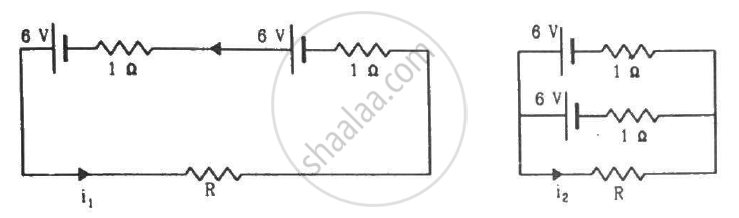
Find the value of i1/i2 in the following figure if (a) R = 0.1 Ω (b) R = 1 Ω and (c) R = 10 Ω. Note from your answers that in order to get more current from a combination of two batteries, they should be joined in parallel if the external resistance is small and in series if the external resistance is large, compared to the internal resistance.
How many time constants will elapse before the power delivered by a battery drops to half of its maximum value in an RC circuit?
Apply the first law of thermodynamics to a resistor carrying a current i. Identify which of the quantities ∆Q, ∆U and ∆W are zero, positive and negative.
Do the electrodes in an electrolytic cell have fixed polarity like a battery?
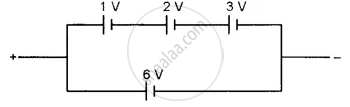
Find the emf of the battery shown in the figure:
A wire of length ‘l’ and resistance 100 Ω is divided into 10 equal parts. The first 5 parts are connected in series while the next 5 parts are connected in parallel. The two combinations are again connected in series. The resistance of this final combination is ______.
When a cell is short-circuited (R = 0), the maximum current that can flow is:
During discharging of a cell, the current direction flows out of:
During charging of a cell, the current direction enters through:
During charging of a cell, the terminal potential difference formula is:
During charging of a cell, how does terminal voltage (V) compare to EMF (ε)?
Internal resistance of a cell increases when the distance between electrodes:
