Two cubes each of volume 27 cm^3 are joined end to end to form a solid. Find the surface area of the resulting cuboid.
Advertisements
प्रश्न
Two cubes each of volume 27 cm3 are joined end to end to form a solid. Find the surface area of the resulting cuboid.
Advertisements
उत्तर

As , volume of a cube = 27 cm3
⇒ (edge)3 = 27
⇒ edge = `root {3}(27)`
⇒ edge = 3 cm
The length of the resulting cuboid , l = 3 + 3 = 6 cm ,
its breath , b = 3 cm and its height , h = 3 cm
Now , the surface area of the resulting cuboid = 2(lb + bh + hl)
= `2 (6 xx 3 + 3 xx 3 + 3 xx 6)`
= 2 (18 + 9 + 18)
= `2 xx 45`
= 90 cm2
APPEARS IN
संबंधित प्रश्न
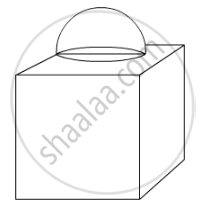
In Fig. 5, is a decorative block, made up two solids – a cube and a hemisphere. The base of the block is a cube of side 6 cm and the hemisphere fixed on the top has diameter of 3.5 cm. Find the total surface area of the bock `(Use pi=22/7)`
The sum of the radius of base and height of a solid right circular cylinder is 37 cm. If the total surface area of the solid cylinder is 1628 sq. cm, find the volume of the cylinder. `("use " pi=22/7)`
A vessel is in the form of a hollow hemisphere mounted by a hollow cylinder. The diameter of the hemisphere is 14 cm and the total height of the vessel is 13 cm. Find the inner surface area of the vessel. [Use `pi = 22/7`]
The internal and external diameters of a hollow hemisphere vessel are 21cm and 25.2 cm The cost of painting 1cm2 of the surface is 10paise. Find total cost to paint the vessel all
over______?
A bucket made of aluminum sheet is of height 20cm and its upper and lower ends are of radius 25cm an 10cm, find cost of making bucket if the aluminum sheet costs Rs 70 per
100 cm2
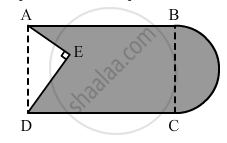
In Figure 4, from a rectangular region ABCD with AB = 20 cm, a right triangle AED with AE = 9 cm and DE = 12 cm, is cut off. On the other end, taking BC as diameter, a semicircle is added on outside the region. Find the area of the shaded region.\[[Use\pi = 3 . 14]\]
The largest cone is curved out from one face of solid cube of side 21 cm. Find the volume of the remaining solid.
Volume and surface area of a solid hemisphere are numerically equal. What is the diameter of hemisphere?
The volume of a hemisphere is 2425 `1/2` cm3 . Find its curved surface area.
In a village, a well with 10 m inside diameter, is dug 14 m deep. Earth taken out of it is spread all around to a width 5 m to form an embankment. Find the height of the embankment. What value of the villagers is reflected here?
How many cubes of 10 cm edge can be put in a cubical box of 1 m edge?
Five identical cubes, each of edge 5 cm, are placed adjacent to each other. Find the volume of the resulting cuboid.
How many lead shots each 3 mm in diameter can be made from a cuboid of dimensions 9 cm × 11 cm × 12 cm?
A plumbline (sahul) is the combination of ______.
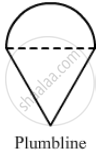
In a right circular cone, the cross-section made by a plane parallel to the base is a ______.
A plumbline (sahul) is the combination of (see figure) ______.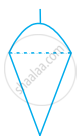
A tent is in the shape of a cylinder surmounted by a conical top. If the height and radius of the cylindrical part are 3 m and 14 m respectively, and the total height of the tent is 13.5 m, find the area of the canvas required for making the tent, keeping a provision of 26 m2 of canvas for stitching and wastage. Also, find the cost of the canvas to be purchased at the rate of ₹ 500 per m2.
The ratio of total surface area of a solid hemisphere to the square of its radius is ______.
Tamper-proof tetra-packed milk guarantees both freshness and security. This milk ensures uncompromised quality, preserving the nutritional values within and making it a reliable choice for health-conscious individuals.
500 ml milk is packed in a cuboidal container of dimensions 15 cm × 8 cm × 5 cm. These milk packets are then packed in cuboidal cartons of dimensions 30 cm × 32 cm × 15 cm.
Based on the above-given information, answer the following questions:
i. Find the volume of the cuboidal carton. (1)
ii. a. Find the total surface area of the milk packet. (2)
OR
b. How many milk packets can be filled in a carton? (2)
iii. How much milk can the cup (as shown in the figure) hold? (1)
