Advertisements
Advertisements
प्रश्न
Transfer the information into a paragraph:
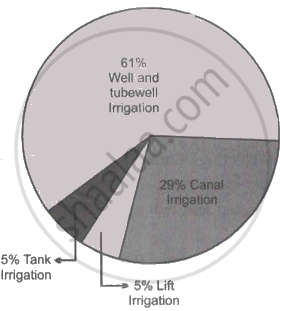
Observe the chart and write a paragraph on it. Suggest a suitable title:

Advertisements
उत्तर
Social Media - New issues
The societal challenges and issues brought on by the technological tsunami are absolutely unprecedented. In particular, teenagers must contend with a mental obstacle that is completely new to them. Teenagers' relationships with one another and their proclivities have changed as a result of the pervasive use of digital technologies. Many youngsters therefore lack crucial interpersonal communication abilities. Teenagers use their smartphones for more than nine hours per day on average.
Teenagers fear new situations like "fear of missing out" due to a technologically induced sense of isolation. Teen feels isolated and their sleeping habits often shift. Additionally, it causes eating issues. Sometimes they assume an untrue facade of "stylish image," smoke, and drink.
Cyberbullying is another issue that has emerged. Exchanging provocative photographs can lead to cyber blackmail, which can lead to heinous cybercrime. This frequently occurs when teenagers experience low self-esteem and resort to immoral means of gaining and maintaining attention. They frequently post things to attract attention. Teenagers, their families, and society at large suffer as a result of social media's ability to give an escape route in the most undesirable way.
APPEARS IN
संबंधित प्रश्न
The chart below shows information on the economics of the Annual
Sports Meet. Study the chart carefully.
| The Economics of the Annual Sports Meet |
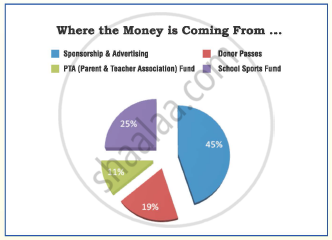
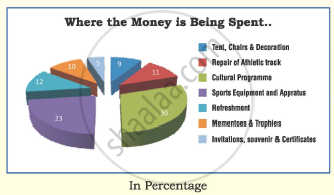
The total cost estimated of the Meet will be~ 11, 00, 000/-
No of athletes : 1250 (750 Girls+ 500 Boys; Category wise: sub-junior: 350, junior: 500 and senior: 400)
Staff on Duty : Teachers: 95 (35 men + 60 women), Support Staff 40 (21 men + 19 women), Staff on Parking and Security duty : 25 (20 men+ 5 women)
No of events : 100 ( 70 Track & Field events and 30 Jumps and Throws)
Medals : 100 Gold, 100Silver& 100Bronze
Best Athlete Trophies : Boys: 3, Girls: 3
Best House Trophies : 4( 1 for each category and 1 over all)
Suppose you are the Prin cipal of the school. Taking information from the chart, prepare an oral presentation for the Management Committee of the school. Use as many expressions of comparison as you can. You have been given some examples.
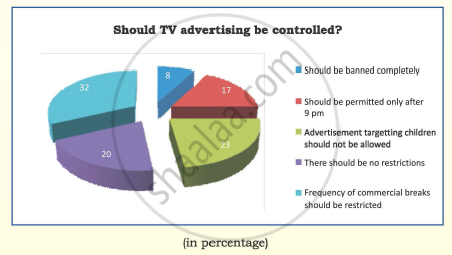
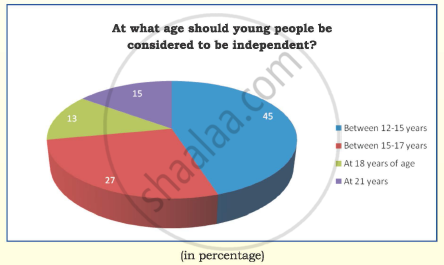
A school carried out two surveys in Class X. Look at the pie charts below and write short summaries of the results as in the model above.
____________________________________________________________________
____________________________________________________________________
____________________________________________________________________
____________________________________________________________________
____________________________________________________________________
____________________________________________________________________
Extend the given extract by adding an imaginary paragraph of your own (about 120 words)
A couple of days later, I was walking around the camp, around the barracks, near the barbed-wire fence where the guards could not easily see. I was alone.
On the other side of the fence, I spotted someone: a little girl with light, almost luminous curls. She was half-hidden behind a birch tree.
I glanced around to make sure no one saw me. I called to her softly in German. 'Do you have something to eat?'
She didn't understand.
I inched closer to the fence and repeated the question in polish. She stepped forward. I was thin and gaunt, with rags wrapped around my feet, but the girl looked unafraid. In her eyes, I saw life.
She pulled an apple from her woollen jacket and threw it over the fence.
I grabbed the fruit and, as I started to run away, I heard her say faintly, 'I'II see you tomorrow."
Read the following tree-diagram and prepare a short paragraph regarding 'Soil Erosion'.

Read the following text and present the information in a tabular form:
Raja Ram Mohan Roy was a zealous social worker holding modern and progressive views. He firmly stood against social bigotry, conservation, and superstition and advocated English and Western Education for his fellowmen. He knew many languages viz English, Persian, Arabic, Latin, French, and even Hebrew. He was born in 1772 in West Bengal. He joined East India Company in 1805. The title ‘Raja’ was conferred on Ram Mohan Roy by the Mogul Emperor. In 1814 he founded the Atmiya Sabha and in 1828 the ‘Brahmo Samaj’. He abolished ‘sati’, child marriage and the purdah. He is rightly called the ‘father of Indian Renaissance’ or the ‘Father of Indian Nationalism’. He died on 27 Sept. 1833 in England.
| Name: | |
| Date of Birth: | |
| III practices abolished: | |
| Institutions launched: | |
| Languages Known: |
Verbal to Non-Verbal:
Read the following information and complete the following table below it:
Chandrayaan-2, India’s second mission to the Moon will, for the first time, unravel secrets around the Moon’s the South Pole. Chandrayaan-2 is a three-part spacecraft - an orbiter, a lander, and a rover. The lander is named Vikram after Vikram Sarabhai, the founder of the Indian space programme. The rover is named Pragyan, meaning ‘wisdom’.
Chandrayaan-2 was launched on 22 July atop ISRO’s GSLV Mk-III at 2:43 p.m. from the Satish Dhawan Space Centre at Sriharikota. Performing as expected, the rocket released Chandrayaan-2 in a highly elliptic orbit around Earth about 17 minutes later. In fact, it was released 6,000 km higher than planned. The solar arrays on Chandrayaan-2 deployed smoothly as the probe began its journey.
| Table | Information | |
| 1. | Name of the Mission | |
| 2. | Date of Launch | |
| 3. | Centre of Launch | |
| 4 | Name of the Rover | |
| 5. | Founder of Indian Space Programme |
Verbal to Non-verbal:
Prepare a fact file using the following points:
Location, Modes of transport, Best time to visit, Accommodation, Places to visit Uniqueness
Ooty or Udhagamandalam’ is a hill station in Tamil Nadu. The queen of the blue mountains sits in the central region of the Nilgiri Range at 7,400 feet, 292 km south west of Bengaluru. The botanical garden, The Ooty Lake, Holy Trinity Church are the places which add to the beauty of Ooty. Wenlock downs is one of the most popular picnic spots in Ooty. Ooty’s hotels range from swanky to budget places. Hotel Surya, Nilgiri Hotel, Khims are some renowned hotels. It is best to visit the place during off season, i.e. March to May to avoid large crowd. Coimbatore is the nearest airport and from there cabs are available to Ooty. From Coimbatore to Udhagamandalam station you may travel by rail or meter gauge. For those taking the road NH 17 Bandipur via Maddur and Mysore will be convenient. From Bandlpur take the route to Mudumalai reserve to Ooty via Gudalur. Ooty is well known for its handmade chocolates, aromatic oils, spices and of course tea.
Non-verbal to verbal
Read the information from the given bar graph and write it in paragraph form.
Non-Verbal to Verbal
Write a paragraph of 100 words based on the information given in the following table and give a suitable title for it:
| Types of Forests | Plants | Animals | |
| (1) |
Equatorial Evergreen |
Mahogany, Rosewood, Ironwood, Oil palm |
Different types of monkeys, snakes, lizards, bats, tse-tse flies |
| (2) | Marshes |
Mangraove, Creepers, Numerous tall trees like Mahogany |
Different types of insects, snakes, crocodiles, tse-tse and other flies |
Draw a table of comparison (tabular form) between Amir and Anita that includes the information given below. Give a suitable title:
|
Amir and Anita are good neighbours. They are cooperative and have happy families. Amir, an 18-year young chap is in std. 12 and goes to a famous college in the city. Anita, a 16-year charming girl will appear for her 10th class Board Exam this year. Amir’s father a big businessman in the city and Anita’s father is a government officer. Amir’s mother, a housewife, helps his father in their family business also. Anita’s mother is a doctor and has her own clinic. Amir is a good sportsman who likes to play outdoor games on the contrary Anita likes to remain indoors and enjoys indoor games. Amir is strong and dynamic. Though strong Anita is sensitive also. Photography and bird-watching are my interests of Amir. Anita spends her time in her hobbies of singing and painting. Amir after his 12th exam wants to pursue his career in wild-life photography. Anita would like to join Arts stream after her Board Exams. |
| Amir | Anita | |
| (1) Age | ||
| (2) Class | ||
| (3) Father’s occupation | ||
| (4) Mother's occupation | ||
| (5) His/Her qualities | ||
| (6) His/Her hobbies/interest | ||
| (7) His/Her ambitions/future plans |
