Advertisements
Advertisements
प्रश्न
Thinking about the Text
Answer these question.
At last a sympathetic audience.”
(i) Who says this?
(ii) Why does he say it?
(iii) Is he sarcastic or serious?
Advertisements
उत्तर
(i) The speaker of the given line is Gerrard.
(ii) He says it as he is asked by the intruder to speak about himself.
(iii) He speaks the given dialogue sarcastically.
संबंधित प्रश्न
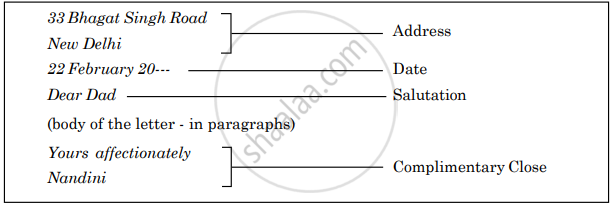
When we write informal letters (to a friend, or to a member of our family), we use this layout.
What does he plant who plants a tree? a
He plants a friend of sun and sky;b
He plants the flag of breezes free;
The shaft of beauty, towering high;
He plants a home to heaven anigh;
For song and mother-croon of bird
In hushed and happy twilight heard____
The treble of heaven's harmony_____
These things he plants who plants a tree.
Read the lines given above and answer the question that follow:
The black man's face bespoke revenge
As the fire passed from his sight.
For all he saw in his stick of wood
Was a chance to spite the white.
The last man of this forlorn group
Did nought except for gain.
Giving only to those who gave
Was how he played the game.
Their logs held tight in death's still hands
Was proof of human sin.
They didn't die from the cold without
They died from the cold within.
Read the lines given above and answer the question that follow.
Discuss personification as used by the poet.
Joe did not see the Guardians of the Poor on that day, on the next, nor on the day following. In fact, he never saw them at all on Maggie’s account, for in less than a week Mrs. Joe Thompson would as soon leave thought of taking up her own abode in the almshouse as sending Maggie there.
What light and blessing did that sick and helpless child bring to the home of Joe Thompson, the poor wheelwright! It had been dark, and cold, and miserable there for a long time just because his wife had nothing to love and care for out of herself, and so became soar, irritable, ill-tempered, and self-afflicting in the desolation of her woman’s nature. Now the sweetness of that sick child, looking ever to her in love, patience, and gratitude, was as honey to her soul, and she carried her in her heart as well as in her arms, a precious burden. As for Joe Thompson, there was not a man in all the neighbourhood who drank daily of a more precious wine of life than he. An angel had come into his house, disguised as a sick, helpless, and miserable child, and filled all its dreary chambers with the sunshine of love.
Read the extract given below and answer the question that follow.
What had changed Mrs Thompson?
Then there it lay in her wet palm, perfect, even pierced ready for use, with the sunset shuffled about inside it like gold—?dust. All her heart went up in flames of joy. After a bit she twisted it into the top of her skirt against her tummy so she would know if it burst through the poor cloth and fell. Then she picked up her fork and sickle and the heavy grass and set off home. Ai! Ai! What a day! Her barefeet smudged out the wriggle— ?mark of snakes in the dust; there was the thin singing of malaria mosquitoes among the trees now; and this track was much used at night by a morose old makna elephant—the Tuskless One; but Sibia was not thinking of any of them. The stars came out: she did not notice. On the way back she met her mother, out of breath, come to look for her, and scolding. “I did not see till I was home, that you were not there. I thought something must have happened to you.” And Sibia, bursting with her story, cried “Something did). I found a blue bead for my necklace, look!”
Read the extract given below and answer the question that follow.
Why did Sibia not tell her mother about her fight with the crocodile or how she saved the woman?
Read the extract given below and answer the questions that follow:
There’s nobody on the house-tops now …..
Just a palsied few at the windows set;
For the best of the sight is, all allow,
At the Shambles’ Gate …… or, better yet,
By the very scaffold’s foot, I trow.
– The Patriot, Robert Browning
(i) Who is the speaker? Where is he being taken? Why?
(ii) Describe the scene when he had walked down the same street a year ago.
(iii) Where does the speaker think all the people had gathered that day? Why does he think so?
(iv) Describe the speaker's physical condition.
(v) What is the central message of the poem? Does the poem and on a note of hope or despair? Give one reason for your answer.
Was it right for the author’s friend to dismantle the bicycle?
What were the primary objectives of the NASA Viking Mission to Mars?
Who made the pact with the Sun and why? How did the pact prove fruitful?
What are the games or human activities which use trees, or in which trees also ‘participate’?
Why is one unable to see a rabbit initially?
What surprises do the meadows have to offer you?
How did Patrick get his wish granted by the elf?
With your partner try to guess the meaning of the underlined phrase.
The afternoon turned black.
Read the newspaper report to find the following facts about Columbia’s ill-fated voyage.
Date and place of lift-off: ____________
Why do you think she/he has these worries? Can you think of ways to get rid of such worries?
Your partner and you may now be able to answer the question.
From the way the child envies the hawker, the gardener, and the watchman, we can guess that there are many things the child has to do, or must not do. Make a list of the do’s and don’ts that the child doesn’t like. The first line is done for you.
| The child must come home at a fixed time. | The child must not get his clothes dirty in the dust. |
|
|
|
Now add to the list your own complaints about the things you have to do, or must not do.
What does he see the gardener doing?
Read the lines given below and answer the following question:
| Iris: Of her society Be not afraid. I met her deity Cutting the clouds towards Paphos, and her son Dove-drawn with her. |
What is meant by “dove drawn”?
In the poem, Dover Beach, where is the "eternal note of sadness" heard?
