Advertisements
Advertisements
प्रश्न
Thinking about the Poem
What does the poet wish for the snake?
Advertisements
उत्तर
The poet wishes that the snake be left unharmed. He wants it to go over the water into the reeds to hide.
संबंधित प्रश्न
Match the meanings with the words/expressions in italic, and write the appropriate
meaning next to the sentence.
The boy hid behind the door, not moving a muscle.
Answer the following question in not more than 100 − 150 words.
How does the author describe Kathmandu’s busiest streets?
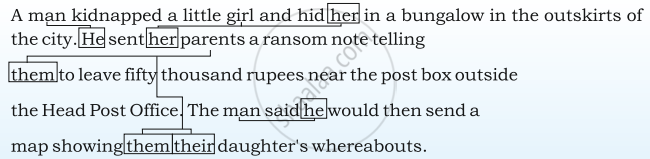
Look at the passage below and study how the personal pronouns refer to different people.
What does he plant who plants a tree?
He plants cool shade and tender rain,
And seed and bud of days to be,
And years that fade and flush again;
He plants the glory of the plain;
He plants the forest's heritage;
The harvest of a coming age;
The joy that unborn eyes shall see___
These things he plants who plants a tree.
Read the lines given above and answer the question that follow:
Explain with reference to context.
'All right!' you 'll cry.'All right!' you'll say,
'But if we take the set away,
What shall we do to entertain
Our darling children?Please explain!'
We'll answer this by asking you,
'What used the darling ones to do?
'How used they keep themselves contented
Before this monster was invented?'
Have you forgotten? Don't you know?
We'll say it very loud and slow:
THEY ... USED ... TO ... READ! They'd READ and READ,
AND READ and READ, and then proceed
To READ some more. Great Scott! Gadzooks!
One half their lives was reading books!
The nursery shelves held books galore!
Books cluttered up the nursery floor!
And in the bedroom, by the bed,
More books were waiting to be read!
Read the lines given above and answer the question given below.
What should be done to keep the children occupied?
The blocks were all lined up for those who would use them
The hundred-yard dash and the race to be run
These were nine resolved athletes in back of the starting line
Poised for the sound of the gun.
The signal was given, the pistol exploded
And so did the runners all charging ahead
But the smallest among them,he stumbled and staggered
And fell to the asphalt instead.
He gave out a cry in frustration and anguish
His dreams ands his efforts all dashed in the dirt
But as sure I'm standing here telling this story
The same goes for what next occurred.
Read the lines given above and answer the following question:
Explain with reference to context.
There was a time when our people covered the land as the waves of a wind-ruffled sea cover its shell-paved floor, but that time long since passed away with the greatness of tribes that are now but a mournful memory. 1 will not dwell on, nor mourn over, our untimely decay, nor reproach my paleface brothers with hastening it, as we too may have been somewhat to blame.
Youth is impulsive. When our young men grow angry at some real or imaginary wrong, and disfigure their faces with black paint, it denotes that their hearts are black, and that they are often cruel and relentless, and our old men and old women are unable to restrain them. Thus it has ever been. Thus it was when the white man began to push our forefathers ever westward. But let us hope that the hostilities between us may never return. We would have everything to lose and nothing to gain. Revenge by young men is considered gain, even at the cost of their own lives, but old men who stay at home in times of war, and mothers who have sons to lose, know better.
Read the extract given below and answer the question that follow.
What does Chief Seattle tell about the condition of his people earlier?
Answer the following question.
“Come here, little one, and I’ll whisper the answer to you.”The crocodile said this because
Answer the following question.
The bear grew up but “he was a most amiable bear”. Give three examples to prove this
Answer the following question.
What did the bear eat? There were two things he was not allowed to do. What were they?
Before fire brigades were set out, how people tried to put out fire.
How did the king reach the rishi’s ashram? Why did the two birds behave with the king differently?
How does the author define ‘sleep’?
What does the child’s mother say about snakes?
Fill in the blank in the sentence below with the words or phrases from the box. (You may not know the meaning of all the words. Look such words up in a dictionary, or ask your teacher.)
Can you ____________ this word in the dictionary?
Discuss the question in pairs before you write the answer.
Who did he finally choose as his master and why?
Complete the following sentence.
The small gray squirrel became friendly when _________
What does Cares say to bless the young couple?
Where did B. Wordsworth live in the short story, B. Wordsworth?
In Act III Scene ii of the play, The Tempest, upon hearing the music of Ariel, Stephanis says that the island will prove to be a “brave kingdom” to him because ______.
