Advertisements
Advertisements
प्रश्न
The third law of Kepler is also known as the Law of ______.
Advertisements
उत्तर
The third law of Kepler is also known as the Law of Harmonies 5.8.
APPEARS IN
संबंधित प्रश्न
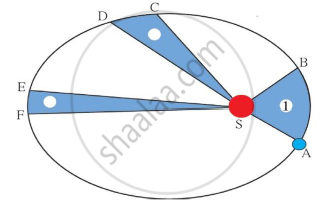
State Kepler's law of orbit and law of equal areas.
A comet orbits the Sun in a highly elliptical orbit. Does the comet have a constant (a) linear speed, (b) angular speed, (c) angular momentum, (d) kinetic energy, (e) potential energy, (f) total energy throughout its orbit? Neglect any mass loss of the comet when it comes very close to the Sun.
Identify the law shown in the figure and state three respective laws.
Answer the following question.
State Kepler’s law of equal areas.
Answer the following question.
State Kepler’s law of the period.
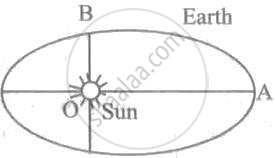
The earth moves around the sun in an elliptical orbit as shown in the figure. The ratio, `"OA"/"OB"` = x. The ratio of the speed of the earth at Band at A is ______.
To verify Kepler's third law graphically four students plotted graphs. Student A plotted a graph of T (period of revolution of planets) versus r (average distance of planets from the sun) and found the plot is straight line with slope 1.85. Student B plotted a graph of T2 v/s r3 and found the plot is straight line with slope 1.39 and negative Y-intercept. Student C plotted graph of log T v/s log r and found the plot is straight line with slope 1.5. Student D plotted graph of log T v/s log r and found the plot is straight line with slope 0.67 and with negative X-intercept. The correct graph is of student
In our solar system, the inter-planetary region has chunks of matter (much smaller in size compared to planets) called asteroids. They ______.
Draw areal velocity versus time graph for mars.
The maximum and minimum distances of a comet from the Sun are 1.6 × 10¹² m and 8.0 × 10¹⁰ m respectively. If the speed of the comet at the nearest point is 6 × 10⁴ ms-1, the speed at the farthest point is ______.
