Advertisements
Advertisements
प्रश्न
The third law of Kepler is also known as the Law of ______.
Advertisements
उत्तर
The third law of Kepler is also known as the Law of Harmonies 5.8.
APPEARS IN
संबंधित प्रश्न
State Kepler's law of orbit and law of equal areas.
Answer the following question in detail.
State Kepler’s three laws of planetary motion.
Observe the given figure and answer these following questions.
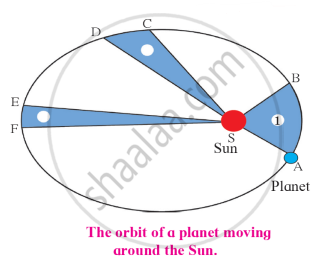
- What is the conclusion about the orbit of a planet?
- What is the relation between velocity of planet and distance from sun?
- ASB, CSD and ESF relation between areas explain.
State Kepler’s laws.
To verify Kepler's third law graphically four students plotted graphs. Student A plotted a graph of T (period of revolution of planets) versus r (average distance of planets from the sun) and found the plot is straight line with slope 1.85. Student B plotted a graph of T2 v/s r3 and found the plot is straight line with slope 1.39 and negative Y-intercept. Student C plotted graph of log T v/s log r and found the plot is straight line with slope 1.5. Student D plotted graph of log T v/s log r and found the plot is straight line with slope 0.67 and with negative X-intercept. The correct graph is of student
If the sun and the planets carried huge amounts of opposite charges ______.
- all three of Kepler’s laws would still be valid.
- only the third law will be valid.
- the second law will not change.
- the first law will still be valid.
Draw areal velocity versus time graph for mars.
A planet revolving in an elliptical orbit has:
- a constant velocity of revolution.
- has the least velocity when it is nearest to the sun.
- its areal velocity is directly proportional to its velocity.
- areal velocity is inversely proportional to its velocity.
- to follow a trajectory such that the areal velocity is constant.
Choose the correct answer from the options given below:
How can an ellipse be drawn using pins and thread?
What is at one focus of the elliptical orbit of a planet?
