Advertisements
Advertisements
प्रश्न
In our solar system, the inter-planetary region has chunks of matter (much smaller in size compared to planets) called asteroids. They ______.
पर्याय
will not move around the sun since they have very small masses compared to sun.
will move in an irregular way because of their small masses and will drift away into outer space.
will move around the sun in closed orbits but not obey Kepler’s laws.
will move in orbits like planets and obey Kepler’s laws.
Advertisements
उत्तर
In our solar system, the inter-planetary region has chunks of matter (much smaller in size compared to planets) called asteroids. They will move in orbits like planets and obey Kepler’s laws.
Explanation:
Because as we know asteroids move in orbits like planet which follows Kepler’s law as they act upon central gravitational forces.
APPEARS IN
संबंधित प्रश्न
State Kepler's law of orbit and law of equal areas.
Identify the law shown in the figure and state three respective laws.
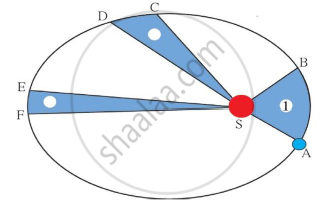
Observe the given figure showing the orbit of a planet moving around the Sun and write the three laws related to it:
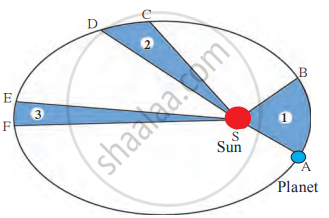
The orbit of a planet moving around the Sun
The orbit of a planet revolving around a star is ______.
The third law of Kepler is also known as the Law of ______.
State Kepler’s laws.
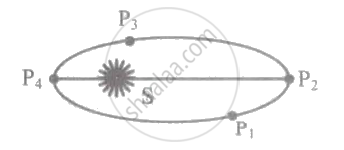
A planet is revolving around the sun in an elliptical orbit as shown in figure. At which point will its K.E. be maximum?
The mass and radius of earth is 'Me' and 'Re' respectively and that of moon is 'Mm' and 'Rm' respectively. The distance between the centre of the earth and that of moon is 'D'. The minimum speed required for a body (mass 'm') to project from a point midway between their centres to escape to infinity is ______.
Both earth and moon are subject to the gravitational force of the sun. As observed from the sun, the orbit of the moon ______.
The centre of mass of an extended body on the surface of the earth and its centre of gravity ______.
- are always at the same point for any size of the body.
- are always at the same point only for spherical bodies.
- can never be at the same point.
- is close to each other for objects, say of sizes less than 100 m.
- both can change if the object is taken deep inside the earth.
Out of aphelion and perihelion, where is the speed of the earth more and why?
A planet revolving in an elliptical orbit has:
- a constant velocity of revolution.
- has the least velocity when it is nearest to the sun.
- its areal velocity is directly proportional to its velocity.
- areal velocity is inversely proportional to its velocity.
- to follow a trajectory such that the areal velocity is constant.
Choose the correct answer from the options given below:
lf the angular momentum of a planet of mass m, moving around the Sun in a circular orbit is L, about the center of the Sun, and its areal velocity is ______.
Halley's Comet revolves around the sun for a time period of 76 years. The aphelion distance if perihelion is given by 8.9 × 10¹⁰ m, will be ______.
(Take, the mass of sun = 2 × 1030 kg and G = 6.67 × 10⁻¹¹ Nm3/kg2)
How can an ellipse be drawn using pins and thread?
What is at one focus of the elliptical orbit of a planet?
When is a planet moving fastest in its orbit?
Two identical particles each of mass ‘m’ go round a circle of radius a under the action of their mutual gravitational attraction. The angular speed of each particle will be ______
