Advertisements
Advertisements
प्रश्न
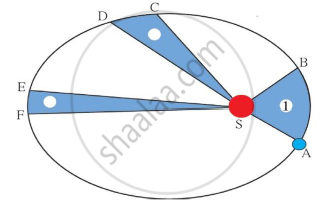
Identify the law shown in the figure and state three respective laws.
Advertisements
उत्तर
Kepler’s laws of planetary motion :
a) The orbit of a planet is an ellipse with the Sun at one of the foci.
b) The line joining the planet and the Sun sweeps equal areas in equal intervals of time.
c) The square of period of revolution of planet around the Sun is directly proportional to the cube of the mean distance of a planet from the Sun.
APPEARS IN
संबंधित प्रश्न
A comet orbits the Sun in a highly elliptical orbit. Does the comet have a constant (a) linear speed, (b) angular speed, (c) angular momentum, (d) kinetic energy, (e) potential energy, (f) total energy throughout its orbit? Neglect any mass loss of the comet when it comes very close to the Sun.
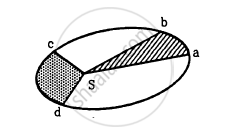
In the Following figure shows the elliptical path of a planet about the sun. The two shaded parts have equal area. If t1 and t2 be the time taken by the planet to go from a to b and from c to d respectively,
Answer the following question.
State Kepler’s law of equal areas.
Observe the given figure showing the orbit of a planet moving around the Sun and write the three laws related to it:
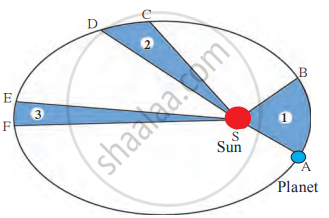
The orbit of a planet moving around the Sun
If the distance between the sun and the earth is made three times, then attraction between the two will ______
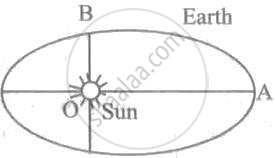
The earth moves around the sun in an elliptical orbit as shown in the figure. The ratio, `"OA"/"OB"` = x. The ratio of the speed of the earth at Band at A is ______.
To verify Kepler's third law graphically four students plotted graphs. Student A plotted a graph of T (period of revolution of planets) versus r (average distance of planets from the sun) and found the plot is straight line with slope 1.85. Student B plotted a graph of T2 v/s r3 and found the plot is straight line with slope 1.39 and negative Y-intercept. Student C plotted graph of log T v/s log r and found the plot is straight line with slope 1.5. Student D plotted graph of log T v/s log r and found the plot is straight line with slope 0.67 and with negative X-intercept. The correct graph is of student
Both earth and moon are subject to the gravitational force of the sun. As observed from the sun, the orbit of the moon ______.
In our solar system, the inter-planetary region has chunks of matter (much smaller in size compared to planets) called asteroids. They ______.
If the sun and the planets carried huge amounts of opposite charges ______.
- all three of Kepler’s laws would still be valid.
- only the third law will be valid.
- the second law will not change.
- the first law will still be valid.
If the sun and the planets carried huge amounts of opposite charges ______.
- all three of Kepler’s laws would still be valid.
- only the third law will be valid.
- the second law will not change.
- the first law will still be valid.
Supposing Newton’s law of gravitation for gravitation forces F1 and F2 between two masses m1 and m2 at positions r1 and r2 read F1 = – F2 = `- r_12/r_12^3 GM_0^2 ((m_1m_2)/M_0^2)^n` where M0 is a constant of dimension of mass r12 = r1 – r2 and n is a number. in such a case.
- the acceleration due to gravity on earth will be different for different objects.
- none of the three laws of Kepler will be valid.
- only the third law will become invalid.
- for n negative, an object lighter than water will sink in water.
Out of aphelion and perihelion, where is the speed of the earth more and why?
A satellite is in an elliptic orbit around the earth with aphelion of 6R and perihelion of 2 R where R= 6400 km is the radius of the earth. Find eccentricity of the orbit. Find the velocity of the satellite at apogee and perigee. What should be done if this satellite has to be transferred to a circular orbit of radius 6R ?
[G = 6.67 × 10⁻¹¹ SI units and M = 6 × 1024 kg]
lf the angular momentum of a planet of mass m, moving around the Sun in a circular orbit is L, about the center of the Sun, and its areal velocity is ______.
What is one practical use of Kepler’s laws?
What is at one focus of the elliptical orbit of a planet?
