Advertisements
Advertisements
प्रश्न
The primary and secondary coils of a transformer each have an inductance of 200 x 10-6 H. The mutual inductance between the windings is 4 x 10⁻⁶ H. What percentage of the flux from one coil reaches the other?
Advertisements
उत्तर १
Data: Lp = LS = 2 × 10⁻⁴ H, M= 4 × 10⁻⁶ H
M = K`sqrt("L"_"p""L"_"S")`
The coupling coefficient is
K = `"M"/sqrt("L"_"p""L"_"S") = (4 xx 10^-6)/sqrt((2xx10^-4)^2) = (4 xx 10^-6)/(2 xx 10^-4)` = 2 × 10⁻²
Therefore, the percentage of flux of the primary reaching the secondary is 0.02 × 100% = 2 %
उत्तर २
Self-inductance, L = 200 × 10-6 H
Mutual inductance, M = 4 × 10⁻⁶ H
Percentage of flux transfer = `"M"/"L" xx 100`
= `(4 xx 10^-6)/(200 xx 10^-6) xx 100`
= 2%
2 % of the flux from one coil reaches the other.
संबंधित प्रश्न
Write the function of a transformer.
Derive an expression for e.m.f. and current in terms of turns ratio
A transformer converts 240 V AC to 60 V AC. The secondary has 75 turns. The number of turns in primary are _______.
(A) 600
(B) 500
(C) 400
(D) 300
Express the turn ratio in terms of voltages.
State the principle of transformer working with the help of a diagram
What type of current is transmitted from the power station?
Complete the following sentence :
……… energy is converted into …………energy by an electric motor.
State two factors on which the magnitude of induced e.m.f. depend.
Name the phenomenon ?
The following diagram in Fig.10.42 shows a coil of several turns of copper wire connected to a sensitive centre zero galvanometer G near a magnet NS. The coil is free to move in the direction shown in the diagram.
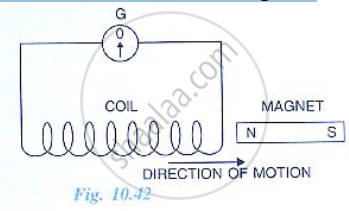
(i) Describe the observation if the coil is rapidly moved.
(ii) How would the observation be altered if (a) the coil has twice as many turns (b the coil was made to move three times as fast?
The following diagram in Fig. 10.44 shows a coil X connected to a sensitive centre –zero galvanometer G and a coil P connected to a battery through a switch S.
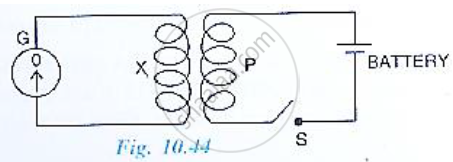
(a) Describe the observation when the switch S is (i) closed suddenly, (ii) then kept closed, (iii) finally opened.
(b) Name and state the law which explains the above observations.
The secondary windings of a transformer in which the voltage is stepped down are usually made of thicker wire than the primary. Explain why.
Why is the iron core of a transformer made laminated (thin sheets) instead of being in one solid piece?
Name two kind of energy loss in a transformer. How is it minimized?
The input and output voltage of a transformer are 220 V and 44 V respectively. Find: the turns ratio.
Given the input current 15 A and the input voltage of 100 V for a step-up transformer having 90% efficiency, find the output power and the voltage in the secondary if the output current is 3 A.
A transformer is used to step up an alternating emf of 200V to 440V. If the primary coil has 1000 turns, calculate the number of turns in the secondary coil.
What is the turns ratio i.e., transformer ratio, ns: np, in an ideal transformer which in-creases ac voltage from 220 V to 33000 V?
In an ideal transformer, an output of 66 kV is required when an input voltage of 220 V is available. If the primary has 300 turns, how many turns should the secondary have?
Can a transformer be used with direct current source? Give reason.
What is the function of a step-up transformer?
Name three losses of energy in a transformer. How are they minimized?
Copy the given diagram of a transformer and complete it. Name the parts A and B. Name the part you have drawn to complete the diagram. What is the material of this part? Is this transformer a step-up or step-down? Give reason.
Applying e.m. f to primary coil is 210 V. If the number of turns in primary coil is 200 turns and that of in secondary coil is 20 turns, then find out the output voltage. Name the type of transformer.
A circular coil of 100 turns with a cross-sectional area of 1 m2 is kept with its plane perpendicular to the magnetic field of 1 T. The magnetic flux linkage is ______.
An ideal transformer has 100 turns in the primary and 250 turns in the secondary. The peak value of the AC is 28 V. The rms secondary voltage is nearest to ______
Explain step up and step down transformer?
Describe the construction and working of a transformer with a neat labelled diagram.
Mention the various energy losses in a transformer.
Give the advantage of AC in long distance power transmission with an illustration.
A step-down transformer connected to the main supply of 220 V is used to operate 11V,88W lamp. Calculate
- Voltage transformation ratio and
- Current in the primary
A 200V/120V step-down transformer of 90% efficiency is connected to an induction stove of resistance 40 Ω. Find the current drawn by the primary of the transformer.
A step-up transformer has 300 turns of primary winding and 450 turns of secondary winding. A primary is connected to 150 V and the current flowing through it is 9A. The current and voltage in the secondary are
The output power in step-up transformer used in practice is ______.
A 220 V input is supplied to a transformer. The output circuit draws a current of 2.0 A at 440 V. If the ratio of output to input power is 0.8, then the current drawn by primary winding is ______.
For an ideal step-down transformer, the quantity which is constant for both the coils is ______.
1 MW power is to be delivered from a power station to a town 10 km away. One uses a pair of Cu wires of radius 0.5 cm for this purpose. Calculate the fraction of ohmic losses to power transmitted if
- power is transmitted at 220 V. Comment on the feasibility of doing this.
- a step-up transformer is used to boost the voltage to 11000 V, power transmitted, then a step-down transfomer is used to bring voltage to 220 V. (ρCu = 1.7 × 10⁻⁸ SI unit)
The magnetic flux through a coil perpendicular to its plane is varying according to the relation Φ = (5t3 + 4t2 + 2t - 5) Weber. If the resistant of the coil is 5 ohm, then the induced current through the coil at t = 2 sec will be ______.
Two coils P and Q are kept near each other. When no current flows through coil P and current increase in coil Q at the rate 10A/s, the emf in coil P is 15mV. When coil Q carries no current and current of 1. 8A flows through coil P, the magnetic flux linked with the coil Q is ______.
Magnetic flux passing through a coil is initially 4 × 10⁻⁴ Wb. It reduces to 10% of its original value in t second. If the emf induced is 0. 72 mV then t in second is ______.
Mention two main sources of power loss in real transformers.
Efficiency of transformer is the ratio of ______.
The primary coil of a transformer has 60 turns whereas its secondary coil has 3000 turns.
If a current of 5A flows in the primary coil, how much current will flow in a load in the secondary coil? State the assumption you have made regarding the transformer, in this calculation.
In an ideal transformer, the turns ratio is \[\frac {N_p}{N_s}\] = \[\frac {1}{2}\]. The ratio Vs : Vp is equal to (the symbols carry their usual meaning) ______.
What does the laminated soft iron core provide for the flux?
Which loss is reduced by laminations in the core?
Which description of the primary coil is correct?
Where is alternating voltage \[V_p\] applied?
What is the induced EMF in the primary coil?
