Advertisements
Advertisements
प्रश्न
The near point of a long-sighted person is 50 cm from the eye.
- Can she see clearly an object at:
- a distance of 20 cm?
- at infinity?
- To read a book held at a distance of 25 cm, will she need converging or diverging spectacle lenses?
Advertisements
उत्तर
-
- A long-sighted person who has a near point of 50 cm from the eye cannot clearly see an object kept at a distance of 20 cm. She can see an object only if it is kept at her near point of 50 cm in front of the eye.
- As the person is long-sighted, she cannot see nearby objects, but can see distant objects clearly. Therefore, she can clearly see the object kept at infinity.
- To read a book held at a distance of 25 cm, the person, who is long-sighted, will need converging lenses.
APPEARS IN
संबंधित प्रश्न
What is myopia?
About 45 lac people in the developing countries are suffering from corneal blindness. About 30 lac children below the age of 12 years suffering from this defect can be cured by replacing the defective cornea with the cornea of a donated eye. How and why can students of your age involve themselves to create awareness about this fact among people?
A student suffering from myopia is not able to see distinctly the objects placed beyond 5 m. List two possible reasons due to which this defect of vision may have arisen. With the help of ray diagrams, explain
(i) why the student is unable to see distinctly the objects placed beyond 5 m from his eyes.
(ii) the type of the corrective lens used to restore proper vision and how this defect is corrected by the use of this lens.
(b) If, in this case, the numerical value of the focal length of the corrective lens is 5 m, find the power of the lens as per the new Cartesian sign convention
Name the defect of vision in which the eye-lens loses its power of accommodation due to old age.
What are the two most common defects of vision (or defects of eye)? How are they corrected?
What is long-sightedness? State the two causes of long-sightedness (or hypermetropia). With the help of ray diagrams, show:
(i) the eye-defect long-sightedness.
(ii) correction of long-sightedness by using a lens.
Describe the mechanism of focusing the image of a distant object in your eye when you raise your head after reading a book.
By closing the eyes and gently pressing them by your palms, you may see some specks of brilliant light. How do you get this sensation while there is no light entering your eyes?
What eye defect is hypermetropia? Describe with a ray diagram how this defect of vision can be corrected by using an appropriate lens.
Draw a ray diagram to show how Hypermetropia is defect can be corrected using a lens.
Given below is a diagram depicting a defect of the human eye? Study the same and answer the question that follow :
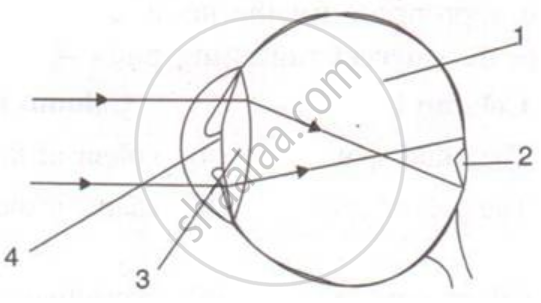
Name the type of lens used to correct this eye defect.
The near point of the eye of a person is 50 cm. Find the nature and power of the corrective lens required by the person to enable him to see clearly the objects placed at 25 cm from the eye?
In what two whys is a yellow spot different from the blind spot?
The diagram given below represents the cross-section of the human eye:

(i) Name the parts labeled 1—12.
(ii) What is the function of the part marked ‘10’?
(iii) What would happen if part ‘5’ is damaged or cut?
Choose the Odd One Out:
Nearsightedness : concave lens : : farsightedness : _______
A person cannot see distinctly objects kept beyond 2 m. This defect can be corrected by using a lens of power:
Myopia may arise due to ____________.
Given alongside is a diagram depicting a defect of the human eye. Study the same and answer the questions that follow:
 |
- Name the defect shown in the diagram.
- Give two possible reasons for this defect.
- Name the parts labelled 1 to 4.
- Name the type of lens used to correct this eye defect.
- Draw a labelled diagram to show how the above mentioned defect is rectified using the lens named above.
