Advertisements
Advertisements
प्रश्न
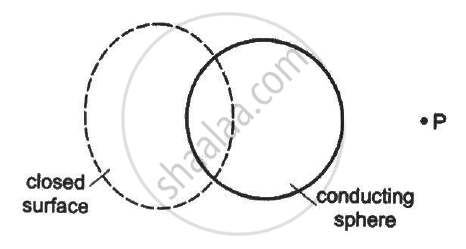
The following figure shows a closed surface that intersects a conducting sphere. If a positive charge is placed at point P, the flux of the electric field through the closed surface
पर्याय
will remain zero
will become positive
will become negative
will become undefined
Advertisements
उत्तर
will become positive
A positive charge at point P will induce a negative charge on the near face of the conducting sphere, whereas the positive charge on the farther end of the sphere. As this father end is enclosed or intersected by the closed surface, so the flux through it will become positive due to the induced positive charge.
APPEARS IN
संबंधित प्रश्न
Define electric flux.
Given the electric field in the region `vecE=2xhati`, find the net electric flux through the cube and the charge enclosed by it.
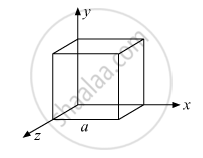
Consider a uniform electric field E = 3 × 10³ `hat i` N/C.
- What is the flux of this field through a square of 10 cm on a side whose plane is parallel to the yz plane?
- What is the flux through the same square if the normal to its plane makes a 60° angle with the x-axis?
What is the net flux of the uniform electric field of previous question through a cube of side 20 cm oriented so that its faces are parallel to the coordinate planes?
A uniformly charged conducting sphere of 2.4 m diameter has a surface charge density of 80.0 μC/m2.
- Find the charge on the sphere.
- What is the total electric flux leaving the surface of the sphere?
Define Electric Flux.
Given a uniform electric field \[\vec{E} = 2 \times {10}^3 \ \hat{i}\] N/C, find the flux of this field through a square of side 20 cm, whose plane is parallel to the y−z plane. What would be the flux through the same square, if the plane makes an angle of 30° with the x−axis ?
A small plane area is rotated in an electric field. In which orientation of the area, is the flux of the electric field through the area maximum? In which orientation is it zero?
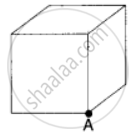
The total flux through the faces of the cube with side of length a if a charge q is placed at corner A of the cube is ______.
Total electric flux coming out of a unit positive charge kept in air is ______.
A point charge q is placed at a distance a/2 directly above the centre of a square of side a. The electric flux through the square is ______.
If the electric flux entering and leaving an enclosed surface respectively is Φ1 and Φ2, the electric charge inside the surface will be
An electric charge q is placed at the center of a cube of side ℓ. The electric flux on one of its faces will be ______.
A circular disc of radius 'r' is placed along the plane of paper. A uniform electric field `vec"E"` is also present in the plane of paper. What amount of electric flux is associated with it?

What is the SI unit of electric flux?
According to the rain analogy for electric flux, what determines how much rain (field) passes through a tilted sheet of cardboard?
What is the key difference between the flux formula for an open surface and a closed surface?
