Advertisements
Advertisements
प्रश्न
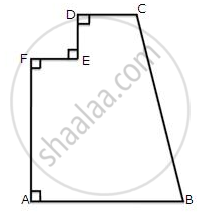
The figure given below shows the cross-section of a concrete structure. Calculate the area of cross-section if AB = 1.8 cm, CD = 0.6 m, DE = 0.8 m, EF = 0.3 m and AF = 1.2 m.
Advertisements
उत्तर
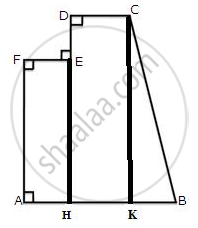
The diagram is redrawn as follows:
Here
AF = 1.2 m, EF = 0.3m, DC = 0.6m, BK = 1.8 - 0.6 - 0.3 = 0.9 m
Hence,
Area of ABCDEF = Area of AHEF + Area of HKCD + ΔKBC
= 1.2 × 0.3 + 2 × 0.6 + `1/2` × 2 × 0.9
= 0.36 + 2.1
= 2.46 sq.m
APPEARS IN
संबंधित प्रश्न
The diagonal of a quadrilateral shaped field is 24 m and the perpendiculars dropped on it from the remaining opposite vertices are 8 m and 13 m. Find the area of the field.
A rectangular plot of land measures 45 m x 30 m. A boundary wall of height 2.4 m is built all around the plot at a distance of 1 m from the plot. Find the area of the inner surface of the boundary wall.
A floor that measures 15 m x 8 m is to be laid with tiles measuring 50 cm x 25 cm. Find the number of tiles required.
Further, if a carpet is laid on the floor so that a space of 1 m exists between its edges and the edges of the floor, what fraction of the floor is left uncovered?
Sum of the areas of two squares is 400 cm2. If the difference of their perimeters is 16 cm, find the sides of the two squares.
The perimeter of a semicircular plate is 108 cm. find its area.
Find the diagonal of a quadrilateral whose area is 756cm2 and the perpendicular from the opposite vertices are 17cm and 19cm.
Find the area of quadrilateral PQRS.

Find the area of the quadrilateral whose vertices are at (– 9, – 2), (– 8, – 4), (2, 2) and (1, – 3)
Find the value of k, if the area of a quadrilateral is 28 sq. units, whose vertices are (– 4, – 2), (– 3, k), (3, – 2) and (2, 3)
When proving that a quadrilateral is a trapezium, it is necessary to show
