Advertisements
Advertisements
प्रश्न
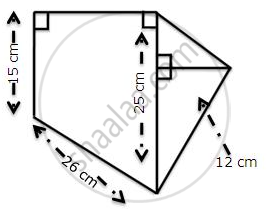
Calculate the area of the figure given below:
Which is not drawn scale.
Advertisements
उत्तर
Here we found two geometrical figures,
One is a triangle and the other is a trapezium.
Now,
Area of the Triangle = `1/2 xx 12 xx 25`
= 150 sq. cm
Area of Trapezium = `1/2 xx ( 25 + 15 ) xx ( sqrt(26^2 - ( 25 - 15 )^2))`
= 20 × 24
= 480 sq. cm
Hence, the area of the whole figure = 150 + 480
= 630 sq. cm
APPEARS IN
संबंधित प्रश्न
Calculate the area of quadrilateral ABCD in which AB = 32 cm, AD = 24 cm ∠A = 90° and BC = CD = 52 cm.
The perimeter of a rhombus is 46 cm. If the height of the rhombus is 8 cm; find its area.
The area of a rhombus is 216 sq. cm. If it's one diagonal is 24 cm; find:
(i) Length of its other diagonal,
(ii) Length of its side,
(iii) The perimeter of the rhombus.
Find the area and the perimeter of a square with diagonal 24 cm. [Take √2 = 1.41 ]
The floor of a room is of size 6 m x 5 m. Find the cost of covering the floor of the room with 50 cm wide carpet at the rate of Rs.24.50 per metre. Also, find the cost of carpeting the same hall if the carpet, 60 cm, wide, is at the rate of Rs.26 per metre.
Vertices of given triangles are taken in order and their areas are provided aside. Find the value of ‘p’.
| Vertices | Area (sq.units) |
| (0, 0), (p, 8), (6, 2) | 20 |
In the following, find the value of ‘a’ for which the given points are collinear
(2, 3), (4, a) and (6, – 3)
Find the area of the quadrilateral whose vertices are at (– 9, – 2), (– 8, – 4), (2, 2) and (1, – 3)
When proving that a quadrilateral is a trapezium, it is necessary to show
When proving that a quadrilateral is a parallelogram by using slopes you must find
