Advertisements
Advertisements
प्रश्न
The capacity of a rectangular tank is 5.2 m3 and the area of its base is 2.6 x 104 cm2; find its height (depth).
Advertisements
उत्तर
Capacity of a tank = 5.2 m3
and area of its base = 2.6 x 104 cm2
= `(2.6 xx 10000)/(100 xx 100) = 2.6`m2
⇒ lb = 2.6 m2
and lbh = 5.2 m3
∴ Height (h) = `5.2/2.6 = 2 "m"`
APPEARS IN
संबंधित प्रश्न
A small indoor greenhouse (herbarium) is made entirely of glass panes (including base) held together with tape. It is 30 cm long, 25 cm wide and 25 cm high. What is the area of the glass?
Find the lateral surface area and total surface area of a cube of edge 10 cm.
An open box is made of wood 3 cm thick. Its external length, breadth and height are 1.48 m, 1.16 m and 8.3 m. Find the cost of painting the inner surface of Rs 50 per sq. metre.
Find the volume of a cuboid whose length = 12 cm, breadth = 8 cm, height = 6 cm.
Find the volume of a cuboid whose length = 15 cm, breadth = 2.5 dm, height = 8 cm.
How many wooden cubical blocks of side 25 cm can be cut from a log of wood of size 3 m by 75 cm by 50 cm, assuming that there is no wastage?
Find the volume in cubic metre (cu. m) of the cuboid whose dimensions islength = 4 m, breadth = 2.5 m, height = 50 cm.
How much clay is dug out in digging a well measuring 3 m by 2 m by 5 m?
A swimming pool is 20 m long 15 m wide and 3 m deep. Find the cost of repairing the floor and wall at the rate of Rs 25 per square metre.
The dimensions of a room are 12.5 m by 9 m by 7 m. There are 2 doors and 4 windows in the room; each door measures 2.5 m by 1.2 m and each window 1.5 m by 1 m. Find the cost of painting the walls at Rs 3.50 per square metre.
A field is 150 m long and 100 m wide. A plot (outside the field) 50 m long and 30 m wide is dug to a depth of 8 m and the earth taken out from the plot is spread evenly in the field. By how much is the level of field raised?
The dimensions of a cinema hall are 100 m, 50 m and 18 m. How many persons can sit in the hall, if each person requires 150 m3 of air?
If the perimeter of each face of a cube is 32 cm, find its lateral surface area. Note that four faces which meet the base of a cube are called its lateral faces.
The surface area of a cuboid is 1300 cm2. If its breadth is 10 cm and height is 20 cm2, find its length.
Three equal cubes are placed adjacently in a row. The ratio of the total surface area of the resulting cuboid to that of the sum of the surface areas of three cubes, is
10 cubic metres clay is uniformly spread on a land of area 10 ares. the rise in the level of the ground is
If A1, A2, and A3 denote the areas of three adjacent faces of a cuboid, then its volume is
The breadth and height of a rectangular solid are 1.20 m and 80 cm respectively. If the volume of the cuboid is 1.92 m3; find its length.
Find the volume of wood required to make a closed box of external dimensions 80 cm, 75 cm, and 60 cm, the thickness of walls of the box being 2 cm throughout.
The ratio between the curved surface area and the total surface area of a cylinder is 1: 2. Find the ratio between the height and the radius of the cylinder.
If radii of two cylinders are in the ratio 4 : 3 and their heights are in the ratio 5: 6, find the ratio of their curved surfaces.
If the edge of a cube is 8 cm long, find its total surface area.
The length, breadth, and height of a rectangular solid are in the ratio 6 : 4 :3. If the total surface area is 1728 cm2. Find its dimensions.
Find the volume of a cuboid whose diagonal is `3sqrt(29)"cm"` when its length, breadth and height are in the ratio 2 : 3 : 4.
A closed box is made of wood 5 mm thick. The external length, breadth and height of the box are 21 cm, 13 cm and 11 cm respectively. Find the volume of the wood used in making the box.
A room is 5m long, 2m broad and 4m high. Calculate the number of persons it can accommodate if each person needs 0.16m3 of air.
Find the volume of wood used in making a closed box 22 cm by 18 cm by 14 cm, using a 1 cm thick wood. Also, find the cost of wood required to make the box at the rate of Rs. 5 per cm³ How many cubes of side 2 cm can be placed in the box?
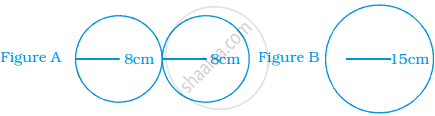
Below are the drawings of cross sections of two different pipes used to fill swimming pools. Figure A is a combination of 2 pipes each having a radius of 8 cm. Figure B is a pipe having a radius of 15 cm. If the force of the flow of water coming out of the pipes is the same in both the cases, which will fill the swimming pool faster?