Advertisements
Advertisements
प्रश्न
Study the following procedure and answer the questions below:
1. Take 3 spheres of iron, copper and lead of equal mass.
2. Put all the 3 spheres in boiling water in a beaker for some time.
3. Take 3 spheres out of the water. Put them immediately on a thick slab of wax.
4. Note, the depth that each sphere goes into the wax.
i) Which property of substance can be studied with this procedure?
ii) Describe that property in minimum words.
iii) Explain the rule of heat exchange with this property.
Advertisements
उत्तर
i. Specific heat
ii. Specific heat : The amount of heat energy required to raise the temperature of a unit mass of an object by 1oC .
iii. According to the principle of hear exchange :
Heat energy lost by the hot object = Heat energy gained by the cold
object
In this activity heat absorbed by iron sphere is transmitted more in the wax, hence sphere goes deepest in to wax, while lead sphere absorbs less heat, resulting in less transmission of heat in the wax hence sphere goes the least depth in the wax.
APPEARS IN
संबंधित प्रश्न
Specific heat capacity of substance A is 3.8 J g-1K-1 whereas the specific heat capacity of substance B is 0.4 J g-1 K-1
(i) Which of the two is a good conductor of heat?
(ii) How is one led to the above conclusion?
(iii) If substances A and B are liquids then which one would be more useful in car radiators?
Write the approximate value of specific heat capacity of water in S.I. unit.
In an experiment to determine the specific heat capacity of a solid following operations were
made:
Mass of calorimeter + stirrer = x kg
Mass of water = y kg
Initial temperature of water t1℃
Mass of solid = z kg
Temperature of solid = t2 ℃
Temperature of mixture = t ℃
Specific heat capacity of calorimeter and water are c1 and c2 respectively. Express the specific
heat capacity c of the solid in terms of the above data.
A heater of power P watt raises the temperature of m kg of a liquid by Δt K in time t s. Express
the specific heat capacity of liquid in terms of above data.
What is meant by global warming?
What is the specific heat capacity of melting ice?
The substances like water which have ........... Heat capacity warm up more slowly than substances like iron which have .......... heat capacity.
What change in heat energy occurs when lead at its melting point
solidifies without change in the temperature?
State factors on which the amount of heat radiated by a body depends.
Write the name.
The amount of heat absorbed at constant temperature by unit mass of a liquid to convert into gaseous phase.
Decide the unit for specific heat capacity.
What is specific heat capacity?
Two uniform brass rods A and B of length land 2l and radii 2r and r respectively are heated to the same temperature. The ratio of the increase in the volume ofB to that of A is ____________.
Heat is applied to a rigid diatomic gas at constant pressure. The ratio ΔQ : ΔU : ΔW is ______.
Specific heat capacity C = ______.
Which of the following substances (A, B and C) has the highest specific heat?
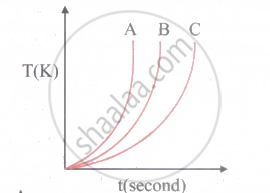
The specific heat capacity of ______ is maximum.
A mixture of one mole of monoatomic gas and one mole of a diatomic gas (rigid) are kept at room temperature (27°C). The ratio of specific heat of gases at constant volume respectively is:
