Advertisements
Advertisements
प्रश्न
State any two symptoms of Down’s syndrome.
Advertisements
उत्तर
Symptoms of Down syndrome are as follows :
1) Most children showed typical facial features with a fold of skin (epicanthal skin fold) over the inner corner of the eye. This results in downward slanting of eyelids
2) The face is typically flat and rounded flat nose, mouth open and tongue protruding
3) Mental retardation
4) Due to poor skeletal development, they have short stature and relatively small skull, the palate is arched.
5) Flat hand with characteristic crease which runs all the way across the palm (simian crease).
APPEARS IN
संबंधित प्रश्न
A colour-blind child is born to a normal couple. Work out a cross to show how it is possible. Mention the sex of this child.
Given below is the representation of amino acid composition not the relevant translated portion of β-chain of haemoglobin, related to the shape of human red blood cells

(a) Is this representation indicating a normal human or a sufferer from certain related genetic disease? Give reason in support of your answer.
(b) What difference would be noticed in the phenotype of the normal and the sufferer related to this gene?
(c) Who are likely to suffer more from the defect related to the gene represented the males, the females or both males and females equally? And why?
Give an account of one Mendelian and one chromosomal disorder you have studied.
A male rabbit of genotype 'AABBDDEE' is crossed with a female rabbit of genotype 'aabbddee' to produce F1 hybrid offspring. How many genetically different gametes can be produced by this F1 hybrid?
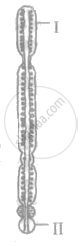
Identify I and II in the given diagram of chromosome.
Match Column I with Column II and select the correct option:
| Column I | Column II | ||
| p. | Pleiotropy | I. | More than two alleles occur at the same locus on homologous chromosomes |
| q. | Multiple alleles | II. | Expression of both the alleles m heterozygous condition |
| r. | Polygenic | III. | Multiple effect of single gene |
| s. | Co-dominance | IV. | Single phenotypic character influenced by more than two genes |
In Klinefelter syndrome, an extra chromosome is a result of non-disjunction of X-chromosome during ____________.
Down’s syndrome is due to ______.
The technique exployed in human genetic counselling is:
Give the genotype of Klinefelter’s syndrome.
