मराठी

Solve the Following Differential Equation:- X Log X D Y D X + Y = 2 X Log X - Mathematics

Advertisements
Advertisements

प्रश्न

Solve the following differential equation:-

\[x \log x\frac{dy}{dx} + y = \frac{2}{x}\log x\]

बेरीज
Advertisements

उत्तर

We have,

\[x \log x\frac{dy}{dx} + y = \frac{2}{x}\log x\]

Dividing both sides by `x log x,` we get

\[\frac{dy}{dx} + \frac{y}{x \log x} = \frac{2}{x}\frac{\log x}{x \log x}\]

\[ \Rightarrow \frac{dy}{dx} + \frac{y}{x \log x} = \frac{2}{x^2}\]

\[ \Rightarrow \frac{dy}{dx} + \left( \frac{1}{x \log x} \right)y = \frac{2}{x^2}\]

\[\text{Comparing with }\frac{dy}{dx} + Py = Q,\text{ we get}\]

\[P = \frac{1}{x \log x} \]

\[Q = \frac{2}{x^2}\]

Now,

\[I . F . = e^{\int P\ dx} \]

\[ = e^{\int\frac{1}{x \log x}dx} \]

\[ = e^{\log\left| \left( \log x \right) \right|} \]

\[ = \log x\]

So, the solution is given by

\[y \times I . F . = \int Q \times I . F . dx + C\]

\[ \Rightarrow y\log x = 2\int\frac{1}{x^2} \times \log x dx + C\]

\[ \Rightarrow y\log x = I + C . . . . . . . . \left( 1 \right)\]

Where,
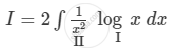
\[ \Rightarrow I = 2\log x\int\frac{1}{x^2} dx - 2\int\left[ \frac{d}{dx}\left( \log x \right)\int\frac{1}{x^2} dx \right]dx\]

\[ \Rightarrow I = \frac{- 2}{x}\log x + 2\int\left[ \frac{1}{x^2} \right]dx\]

\[ \Rightarrow I = \frac{- 2}{x}\log x - \frac{2}{x} . . . . . . . . \left( 2 \right)\]

From (1) and (2) we get

\[ \therefore y\log x = \frac{- 2}{x}\log x - \frac{2}{x} + C\]

\[ \Rightarrow y\log x = \frac{- 2}{x}\left( \log x + 1 \right) + C\]

shaalaa.com
  या प्रश्नात किंवा उत्तरात काही त्रुटी आहे का?
पाठ 22: Differential Equations - Revision Exercise [पृष्ठ १४७]

APPEARS IN

आरडी शर्मा Mathematics [English] Class 12
पाठ 22 Differential Equations
Revision Exercise | Q 66.11 | पृष्ठ १४७

व्हिडिओ ट्यूटोरियलVIEW ALL [2]

संबंधित प्रश्‍न

Find the particular solution of the differential equation  `e^xsqrt(1-y^2)dx+y/xdy=0` , given that y=1 when x=0


Form the differential equation of the family of circles in the second quadrant and touching the coordinate axes.


Find the differential equation representing the curve y = cx + c2.


Find the particular solution of differential equation:

`dy/dx=-(x+ycosx)/(1+sinx) " given that " y= 1 " when "x = 0`


Find the general solution of the following differential equation : 

`(1+y^2)+(x-e^(tan^(-1)y))dy/dx= 0`


Verify that the given function (explicit or implicit) is a solution of the corresponding differential equation:

y = x sin x : xy' = `y + x  sqrt (x^2 - y^2)`  (x ≠ 0 and x > y or x < -y)


Find the general solution of the differential equation `dy/dx + sqrt((1-y^2)/(1-x^2)) = 0.`


Show that the general solution of the differential equation  `dy/dx + (y^2 + y +1)/(x^2 + x + 1) = 0` is given by (x + y + 1) = A (1 - x - y - 2xy), where A is parameter.


if `y = sin^(-1) (6xsqrt(1-9x^2))`, `1/(3sqrt2) < x < 1/(3sqrt2)` then find `(dy)/(dx)`


The general solution of the differential equation \[\frac{dy}{dx} = \frac{y}{x}\] is


Solution of the differential equation \[\frac{dy}{dx} + \frac{y}{x}=\sin x\] is


The solution of the differential equation (x2 + 1) \[\frac{dy}{dx}\] + (y2 + 1) = 0, is


The general solution of a differential equation of the type \[\frac{dx}{dy} + P_1 x = Q_1\] is


The general solution of the differential equation ex dy + (y ex + 2x) dx = 0 is


(1 + y + x2 y) dx + (x + x3) dy = 0


`y sec^2 x + (y + 7) tan x(dy)/(dx)=0`


`(2ax+x^2)(dy)/(dx)=a^2+2ax`


\[\frac{dy}{dx} + y = 4x\]


\[\frac{dy}{dx} + 5y = \cos 4x\]


Find the particular solution of the differential equation \[\frac{dy}{dx} = - 4x y^2\] given that y = 1, when x = 0.


For the following differential equation, find the general solution:- \[\frac{dy}{dx} = \frac{1 - \cos x}{1 + \cos x}\]


For the following differential equation, find the general solution:- \[\frac{dy}{dx} = \sqrt{4 - y^2}, - 2 < y < 2\]


Solve the following differential equation:-

\[\frac{dy}{dx} + \frac{y}{x} = x^2\]


Solve the following differential equation:-

\[\left( x + y \right)\frac{dy}{dx} = 1\]


Find a particular solution of the following differential equation:- (x + y) dy + (x − y) dx = 0; y = 1 when x = 1


Find the equation of the curve passing through the point (1, 1) whose differential equation is x dy = (2x2 + 1) dx, x ≠ 0.


Solve the differential equation:  ` ("x" + 1) (d"y")/(d"x") = 2e^-"y" - 1; y(0) = 0.`


Solution of the differential equation `"dx"/x + "dy"/y` = 0 is ______.


The general solution of the differential equation x(1 + y2)dx + y(1 + x2)dy = 0 is (1 + x2)(1 + y2) = k.


Integrating factor of `(x"d"y)/("d"x) - y = x^4 - 3x` is ______.


Solution of `("d"y)/("d"x) - y` = 1, y(0) = 1 is given by ______.


The solution of the differential equation `("d"y)/("d"x) + (1 + y^2)/(1 + x^2)` is ______.


The solution of `("d"y)/("d"x) = (y/x)^(1/3)` is `y^(2/3) - x^(2/3)` = c.


Find the particular solution of the following differential equation, given that y = 0 when x = `pi/4`.

`(dy)/(dx) + ycotx = 2/(1 + sinx)`


Find the general solution of the differential equation:

`(dy)/(dx) = (3e^(2x) + 3e^(4x))/(e^x + e^-x)`


The curve passing through (0, 1) and satisfying `sin(dy/dx) = 1/2` is ______.


The differential equation of all parabolas that have origin as vertex and y-axis as axis of symmetry is ______.


If the solution curve of the differential equation `(dy)/(dx) = (x + y - 2)/(x - y)` passes through the point (2, 1) and (k + 1, 2), k > 0, then ______.


Share
Notifications

Englishहिंदीमराठी


      Forgot password?
Use app×