हिंदी

Solve the Following Differential Equation:- X Log X D Y D X + Y = 2 X Log X - Mathematics

Advertisements
Advertisements

प्रश्न

Solve the following differential equation:-

\[x \log x\frac{dy}{dx} + y = \frac{2}{x}\log x\]

योग
Advertisements

उत्तर

We have,

\[x \log x\frac{dy}{dx} + y = \frac{2}{x}\log x\]

Dividing both sides by `x log x,` we get

\[\frac{dy}{dx} + \frac{y}{x \log x} = \frac{2}{x}\frac{\log x}{x \log x}\]

\[ \Rightarrow \frac{dy}{dx} + \frac{y}{x \log x} = \frac{2}{x^2}\]

\[ \Rightarrow \frac{dy}{dx} + \left( \frac{1}{x \log x} \right)y = \frac{2}{x^2}\]

\[\text{Comparing with }\frac{dy}{dx} + Py = Q,\text{ we get}\]

\[P = \frac{1}{x \log x} \]

\[Q = \frac{2}{x^2}\]

Now,

\[I . F . = e^{\int P\ dx} \]

\[ = e^{\int\frac{1}{x \log x}dx} \]

\[ = e^{\log\left| \left( \log x \right) \right|} \]

\[ = \log x\]

So, the solution is given by

\[y \times I . F . = \int Q \times I . F . dx + C\]

\[ \Rightarrow y\log x = 2\int\frac{1}{x^2} \times \log x dx + C\]

\[ \Rightarrow y\log x = I + C . . . . . . . . \left( 1 \right)\]

Where,
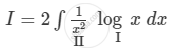
\[ \Rightarrow I = 2\log x\int\frac{1}{x^2} dx - 2\int\left[ \frac{d}{dx}\left( \log x \right)\int\frac{1}{x^2} dx \right]dx\]

\[ \Rightarrow I = \frac{- 2}{x}\log x + 2\int\left[ \frac{1}{x^2} \right]dx\]

\[ \Rightarrow I = \frac{- 2}{x}\log x - \frac{2}{x} . . . . . . . . \left( 2 \right)\]

From (1) and (2) we get

\[ \therefore y\log x = \frac{- 2}{x}\log x - \frac{2}{x} + C\]

\[ \Rightarrow y\log x = \frac{- 2}{x}\left( \log x + 1 \right) + C\]

shaalaa.com
  क्या इस प्रश्न या उत्तर में कोई त्रुटि है?
अध्याय 22: Differential Equations - Revision Exercise [पृष्ठ १४७]

APPEARS IN

आरडी शर्मा Mathematics [English] Class 12
अध्याय 22 Differential Equations
Revision Exercise | Q 66.11 | पृष्ठ १४७

वीडियो ट्यूटोरियलVIEW ALL [2]

संबंधित प्रश्न

Solve : 3ex tanydx + (1 +ex) sec2 ydy = 0

Also, find the particular solution when x = 0 and y = π.


Find the particular solution of the differential equation  `e^xsqrt(1-y^2)dx+y/xdy=0` , given that y=1 when x=0


Find the differential equation representing the curve y = cx + c2.


Find the particular solution of the differential equation `dy/dx=(xy)/(x^2+y^2)` given that y = 1, when x = 0.


Verify that the given function (explicit or implicit) is a solution of the corresponding differential equation:

y = ex + 1  :  y″ – y′ = 0


Verify that the given function (explicit or implicit) is a solution of the corresponding differential equation:

y = Ax : xy′ = y (x ≠ 0)


Verify that the given function (explicit or implicit) is a solution of the corresponding differential equation:

y = x sin x : xy' = `y + x  sqrt (x^2 - y^2)`  (x ≠ 0 and x > y or x < -y)


Find the general solution of the differential equation `dy/dx + sqrt((1-y^2)/(1-x^2)) = 0.`


If y = etan x+ (log x)tan x then find dy/dx


if `y = sin^(-1) (6xsqrt(1-9x^2))`, `1/(3sqrt2) < x < 1/(3sqrt2)` then find `(dy)/(dx)`


The population of a town grows at the rate of 10% per year. Using differential equation, find how long will it take for the population to grow 4 times.


Write the order of the differential equation associated with the primitive y = C1 + C2 ex + C3 e−2x + C4, where C1, C2, C3, C4 are arbitrary constants.


The general solution of the differential equation \[\frac{dy}{dx} + y \] cot x = cosec x, is


The solution of the differential equation \[\frac{dy}{dx} + \frac{2y}{x} = 0\] with y(1) = 1 is given by


The solution of the differential equation x dx + y dy = x2 y dy − y2 x dx, is


The number of arbitrary constants in the general solution of differential equation of fourth order is


Which of the following differential equations has y = x as one of its particular solution?


cos (x + y) dy = dx


\[\frac{dy}{dx} + \frac{y}{x} = \frac{y^2}{x^2}\]


(x + y − 1) dy = (x + y) dx


(x2 + 1) dy + (2y − 1) dx = 0


`2 cos x(dy)/(dx)+4y sin x = sin 2x," given that "y = 0" when "x = pi/3.`


`(dy)/(dx)+ y tan x = x^n cos x, n ne− 1`


Find the general solution of the differential equation \[\frac{dy}{dx} = \frac{x + 1}{2 - y}, y \neq 2\]


Find the particular solution of the differential equation \[\frac{dy}{dx} = - 4x y^2\] given that y = 1, when x = 0.


For the following differential equation, find the general solution:- \[\frac{dy}{dx} + y = 1\]


Solve the following differential equation:-

\[x\frac{dy}{dx} + 2y = x^2 \log x\]


Solve the following differential equation:-

\[\left( x + y \right)\frac{dy}{dx} = 1\]


Solve the following differential equation:-

y dx + (x − y2) dy = 0


Find a particular solution of the following differential equation:- \[\left( 1 + x^2 \right)\frac{dy}{dx} + 2xy = \frac{1}{1 + x^2}; y = 0,\text{ when }x = 1\]


Find the differential equation of all non-horizontal lines in a plane.


y = x is a particular solution of the differential equation `("d"^2y)/("d"x^2) - x^2 "dy"/"dx" + xy` = x.


Solution of `("d"y)/("d"x) - y` = 1, y(0) = 1 is given by ______.


The general solution of ex cosy dx – ex siny dy = 0 is ______.


Which of the following is the general solution of `("d"^2y)/("d"x^2) - 2 ("d"y)/("d"x) + y` = 0?


The solution of the differential equation `("d"y)/("d"x) = "e"^(x - y) + x^2 "e"^-y` is ______.


Polio drops are delivered to 50 K children in a district. The rate at which polio drops are given is directly proportional to the number of children who have not been administered the drops. By the end of 2nd week half the children have been given the polio drops. How many will have been given the drops by the end of 3rd week can be estimated using the solution to the differential equation `"dy"/"dx" = "k"(50 - "y")` where x denotes the number of weeks and y the number of children who have been given the drops.

The value of c in the particular solution given that y(0) = 0 and k = 0.049 is ______.


The differential equation of all parabolas that have origin as vertex and y-axis as axis of symmetry is ______.


Share
Notifications

Englishहिंदीमराठी


      Forgot password?
Use app×