Advertisements
Advertisements
प्रश्न
Read the passage given below and answer the questions (i), (ii) and (iii) that follow:
|
(1) |
Something happens to cats after we have enjoyed a delicious meal. Call it a feline sugar hit or a rush of good feelings. Abandoning our usually sedentary nature, we transform into crazy beasts who thunder down corridors, spring from one piece of furniture to another, or pounce from behind half-closed doors to attack the shoelaces of unsuspecting passersby. It is as though we are temporarily possessed. |
5 |
|
(2) |
That, at least, is my excuse, dear reader - and the only explanation I can offer for my entirely unplanned global TV debut. |
|
|
(3) |
To be fair, I had no way of knowing that my master was receiving visitors that particular afternoon. Nor that he was being interviewed live, let alone by one of America’s most famous journalists. |
10 |
|
(4) |
All I knew was that, a few minutes after gorging myself on a favourite treat of creamy pudding, I felt that sudden, primal explosion of energy. I made my way back to the suite of rooms that I shared with my master and felt an overpowering compulsion to do something completely mad. I wanted to run like a furious jungle cat, at that particular moment. |
15 |
|
(5) |
Bursting through the door of the room in which my master received visitors, I tore up the carpet as I raced towards the sofa opposite where he was sitting. I ripped its fabric as I scrambled up its side like a savage creature clawing its way up a perilous cliff. Then with a final, frenzied burst, I launched myself off one arm of the sofa, leaping towards the other. |
20 |
|
(6) |
It was only at this point that I realised the sofa was occupied by the journalist. She was halfway through a sentence, and my abrupt appearance caught my master's guest completely by surprise. |
|
|
(7) |
You know, when something truly unexpected happens, time can seem to slow down. Well, that’s how it was. As I flew past the woman's face, her expression turned from one of calm engagement to that of total surprise. |
25 |
|
(8) |
I As she pushed back in her seat to avoid me, the shock on her face could not have been more evident. |
|
|
(9) |
But, dear reader, she was not more shaken than me. I had not been expecting anyone on the sofa, let alone a TV celebrity, nor one who was mid-interview. As I headed towards the opposite end of the sofa, for the first time I observed the lighting, the cameras and the crew watching the action from the shadows. By the time I landed on the other arm of the sofa, all the energy that had propelled me was gone. |
30
35 |
|
(10) |
I was, no longer, a furious jungle cat. |
|
|
(11) |
The journalist looked at me. I looked at her. Both of us were taking in what had just happened. I was also conscious of the cameras still rolling as well as many pairs of eyes watching me at that moment. My moment of global glory. |
|
|
|
Adapted from: The Dalai Lama's Cat Omnibus |
|
(i)
- Given below are three words and phrases. Find the words which have a similar meaning in the passage: [3]
- inactive
- eating in a greedy manner
- dangerous
- For each of the words given below, write a sentence of at least ten words using the same word unchanged in form, but with a different meaning from that which it carries in the passage: [3]
- thunder (line 3)
- spring (line 3)
- past (line 26)
(ii) Answer the following questions in your own words as briefly as possible:
- What is the usual nature of the narrator's kind? How is it differently presented in the passage? [2]
- What did the 'favourite treat of creamy pudding' do to the narrator? [2]
- Describe the actions of the narrator after bursting into the visitors' room. [2]
- How did the journalist react when the narrator 'flew past' her face? [2]
(iii) Summarise how the narrator became a global celebrity (paragraphs 4 to 11). You are required to write the summary in the form of a connected passage in about 100 words. Failure to keep within the word limit will be penalised. [6]
Advertisements
उत्तर
(i)
-
- sedentary
- gorging
- perilous
- The distant rumble of thunder foreshadowed the arrival of a heavy storm.
- The family eagerly awaited spring, when flowers would start blooming across their garden.
- She always felt nostalgic when looking back at her childhood past.
(ii)
- The passage illustrates that felines, after a satisfying meal, exhibit heightened energy and playfulness, discarding their usual sedentary habits for spontaneous and unfamiliar behavior, almost as if they were under the influence of an intoxicating substance, akin to a human being.
- He experienced a burst of intense energy, desiring to engage in something daring and sprint wildly, much like a jungle cat.
- Initially, he shredded the carpet using his claws, followed by tearing the fabric of the sofa. Not content with that, he jumped from one arm of the sofa to another.
- The lady journalist's initially calm expression transformed into one of surprise. She moved her chair back to distance herself from him, her face now displaying a shocked expression.
(iii) After enjoying a preferred treat, the narrator is suddenly filled with energy and rushes into the room where his owner is being interviewed live by a renowned American journalist. Unaware that the sofa is already occupied, the cat damages the carpet and climbs the sofa, tearing its fabric. This unexpected behaviour startles the journalist, who moves back to avoid the cat, and the cameras capture this unplanned event. Both the journalist and the cat exchange glances, processing the surprising turn of events. In a moment of unforeseen fame, the cat unintentionally becomes a global celebrity.
APPEARS IN
संबंधित प्रश्न
Thinking about the Poem
What does the poet like to do when it rains?
What is the single major memory that comes to the poet? Who are the “darling
dreamers” he refers to?
Imagine that you are the poet, William Wordsworth. You continue on your walk, and when you reach home you tell a friend what you saw and felt. Which of the following best describes your experience? (Work in pairs, then have a class discussion.)
|
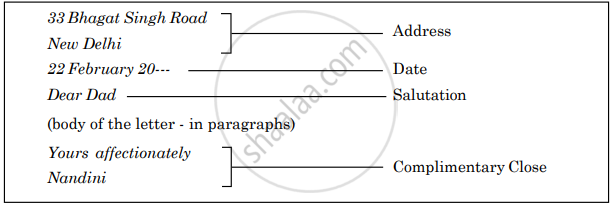
When we write informal letters (to a friend, or to a member of our family), we use this layout.
Some are like fields of sunlit corn,
Meet for a bride on her bridal morn,
Some, like the flame of her marriage fire,
Or, rich with the hue of her heart's desire,
Tinkling,luminous,tender, and clear,
Like her bridal laughter and bridal tear.
Read the lines given above and answer the question that follow.
Explain:
Some, like the flame of her marriage fire,
Or, rich with the hue of her heart’s desire,
Continuous as the stars that shine
And twinkle on the milky way,
They stretched in never-ending line
Along the margin of a bay:
Ten thousand saw I at a glance,
Tossing their heads in springhtly dance.
Read the lines given above and answer the question that follow.
What were the daffodils doing? Which literary device is used here?
The blocks were all lined up for those who would use them
The hundred-yard dash and the race to be run
These were nine resolved athletes in back of the starting line
Poised for the sound of the gun.
The signal was given, the pistol exploded
And so did the runners all charging ahead
But the smallest among them,he stumbled and staggered
And fell to the asphalt instead.
He gave out a cry in frustration and anguish
His dreams ands his efforts all dashed in the dirt
But as sure I'm standing here telling this story
The same goes for what next occurred.
Read the lines given above and answer the following question:
The word ‘exploded’ is used for the firing of the pistol. What does the phrase ‘so did the runners’ in line 2 of stanza 4 mean?
To us the ashes of our ancestors are sacred and their resting place is hallowed ground. You wander far from the graves of your ancestors and seemingly without regret. Your religion was written upon tablets of stone by the iron finger of your God so that you could not forget. The Red Man could never comprehend or remember it. Our religion is the traditions of our ancestors — the dreams of our old men, given them in solemn hours of the night by the Great Spirit; and the visions of our sachems, and is written in the hearts of our people.
Day and night cannot dwell together. The Red Man has ever fled the approach of the White Man, as the morning mist flees before the morning sun. However, your proposition seems fair and I think that my people will accept it and will retire to the reservation you offer them. Then we will dwell apart in peace, for the words of the Great White Chief seem to be the words of nature speaking to my people out of dense darkness.
Read the extract given below and answer the question that follow.
How do the tribal men regard the ashes of their ancestors?
Mrs. Thompson did not reply, but presently turned towards the little chamber where her husband had deposited Maggie; and, pushing open the door, went quietly in. Joe did not follow; he saw that, her state had changed, and felt that it would be best to leave her alone with the child. So he went to his shop, which stood near the house, and worked until dusky evening released him from labor. A light shining through the little chamber windows was the first object that attracted Joe’s attention on turning towards the house: it was a good omen. The path led him by this windows and, when opposite, he could not help pausing to look in. It was now dark enough outside to screen him from observation. Maggie lay, a little raised on the pillow with the lamp shining full upon her face. Mrs. Thompson was sitting by the bed, talking to the child; but her back was towards the window, so that her countenance was not seen. From Maggie’s face, therefore, Joe must read the character of their intercourse. He saw that her eyes were intently fixed upon his wife; that now and then a few words came, as if in answers from her lips; that her expression was sad and tender; but he saw nothing of bitterness or pain. A deep-drawn breath was followed by one of relief, as a weight lifted itself from his heart.
Read the extract given below and answer the question that follow.
Why was Joe relieved?
After washing from his hands and face the dust and soil of work, Joe left the kitchen, and went to the little bedroom. A pair of large bright eyes looked up at him from the snowy bed; looked at him tenderly, gratefully, pleadingly. How his heart swelled in his bosom! With what a quicker motion came the heart-beats! Joe sat down, and now, for the first time, examining the thin free carefully under the lamp light, saw that it was an attractive face, and full of a childish sweetness which suffering had not been able to obliterate.
“Your name is Maggie?” he said, as he sat down and took her soft little hand in his.
“Yes, sir.” Her voice struck a chord that quivered in a low strain of music.
“Have you been sick long?”
“Yes, sir.” What a sweet patience was in her tone!
“Has the doctor been to see you?”
“He used to come”
“But not lately?”
“No, sir.”
Read the extract given below and answer the questions that follow.
What did Joe notice about Maggie in the light of the lamp?
After washing from his hands and face the dust and soil of work, Joe left the kitchen, and went to the little bedroom. A pair of large bright eyes looked up at him from the snowy bed; looked at him tenderly, gratefully, pleadingly. How his heart swelled in his bosom! With what a quicker motion came the heart-beats! Joe sat down, and now, for the first time, examining the thin free carefully under the lamp light, saw that it was an attractive face, and full of a childish sweetness which suffering had not been able to obliterate.
“Your name is Maggie?” he said, as he sat down and took her soft little hand in his.
“Yes, sir.” Her voice struck a chord that quivered in a low strain of music.
“Have you been sick long?”
“Yes, sir.” What a sweet patience was in her tone!
“Has the doctor been to see you?”
“He used to come”
“But not lately?”
“No, sir.”
Read the extract given below and answer the questions that follow.
What does Maggie tell Joe?
Most terribly cold it was; it snowed, and was nearly quite dark, and evening— the last evening of the year. In this cold and darkness there went along the street a poor little girl, bareheaded, and with naked feet. When she left home she had slippers on, it is true; but what was the good of that? They were very large slippers, which her mother had hitherto worn; so large were they; and the poor little thing lost them as she scuffled away across the street, because of two carriages that rolled by dreadfully fast.
One slipper was nowhere to be found; the other had been laid hold of by an urchin, and off he ran with it; he thought it would do capitally for a cradle when he some day or other should have children himself. So the little maiden walked on with her tiny naked feet, that were quite red and blue from cold. She carried a quantity of matches in an old apron, and she held a bundle of them in her hand. Nobody had bought anything of her the whole livelong day; no one had given her a single farthing. She crept along trembling with cold and hunger—a very picture of sorrow, the poor little thing!
Read the extract given below and answer the question that follow.
Which day of the year was it in the story?
Why is Mr. Purcell compared to an owl?
Answer the following question.
Where did the lady find the bear cub? How did she bring it up?
Answer the following question.
What happened one Sunday when the lady was going to her sister’shouse? What did the lady do? What was the bear’s reaction?
Tilloo pressed the red button and “the damage was done”. What was the damage?
Discuss the following topic in groups
What, if anything, might drive mankind to make their homes underground?
Discuss in small groups
• Has Rukku Manni done exactly the same as the children? In your opinion, then, is it right for one party to blame the other?
Why did the author went to the shoe shop for the last time?
What do you think the man said to his friend who waited at the door?
Who were the two last-minute shoppers to Ray’s shop?
Make noun from the word given below by adding –ness, ity, ty or y
Great ___________.
Why did the Dog say goodbye to the Wolf?
Mark the right item:
“This, said the emperor, was to encourage all children to honour and obey their parents.”
‘This’ refers to ______
Multiple Choice Question:
What does the expression leave their greens’ mean?
"Since I don’t know when" suggests ...
What else do you think Nishad and Maya will find out about him? How? Will they ever be friends? Think about these questions and write a paragraph or two to continue the story.
Where does Portia say that she and Narissa will stay until their husbands return?
Select the option that shows the correct relationship between statements (1) and (2) from William Sleator’s short story, ‘The Elevator’.
Statement 1: Terrified of the fat lady in the elevator, Martin ran down the dark stairs, fell and broke his leg.
Statement 2: Angry and disappointed that his son had behaved like a fool and a coward, Martin’s father did not talk to him on the way to the hospital.
Read the following extract from Maya Angelou’s poem, ‘When Great Trees Fall’ and answer the questions that follow:
| When great trees fall in forests, small things recoil into silence, their senses eroded beyond fear. |
- What effect does the falling of a ‘great tree’ have on the creatures of the forest? [3]
- How does the death of a great soul affect the lives of those left behind in the immediate aftermath of their passing? [3]
- What long-term effect does the death of a ‘great soul' have? [3]
- What feeling is being expressed by the following lines/phrases? [3]
- small things recoil into silence
- kind words/unsaid,
- Beand be/better. For they existed
- What is a ‘Great tree’ a metaphor for? [4]
What is the central message of Angelou’s poem, “When Great Trees Fall"?
