Advertisements
Advertisements
प्रश्न
(b) Rate constant ‘k’ of a reaction varies with temperature ‘T’ according to the equation:
`logk=logA-E_a/2.303R(1/T)`
Where Ea is the activation energy. When a graph is plotted for `logk Vs. 1/T` a straight line with a slope of −4250 K is obtained. Calculate ‘Ea’ for the reaction.(R = 8.314 JK−1 mol−1)
Advertisements
उत्तर
`log k=logA-E_a/2.303R(1/T)`
Ea → Activation energy
The above equation is like y = mx + c where if we plot y v/s x we get a straight line with slope ‘m’ and intercept ‘c’.
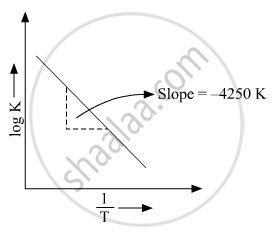
So, slope is equal to`=-E_a/2.303R`
`-E_a/2.303R=-4250k=>E_a=4250 xx 2.303 xx 8.314 =81,375.3535 j mol^(-1)`
`E_a=81.3753 KJ mol^(-1)`
APPEARS IN
संबंधित प्रश्न
Consider the reaction
`3I_((aq))^-) +S_2O_8^(2-)->I_(3(aq))^-) + 2S_2O_4^(2-)`
At particular time t, `(d[SO_4^(2-)])/dt=2.2xx10^(-2)"M/s"`
What are the values of the following at the same time?
a. `-(d[I^-])/dt`
b. `-(d[S_2O_8^(2-)])/dt`
c. `-(d[I_3^-])/dt`
The rate constant for the decomposition of hydrocarbons is 2.418 × 10⁻⁵ s−1 at 546 K. If the energy of activation is 179.9 kJ/mol, what will be the value of pre-exponential factor?
The rate of a reaction quadruples when the temperature changes from 293 K to 313 K. Calculate the energy of activation of the reaction assuming that it does not change with temperature.
In the Arrhenius equation for a first order reaction, the values of ‘A’ of ‘Ea’ are 4 × 10¹³ sec−1 and 98.6 kJ mol−1 respectively. At what temperature will its half life period be 10 minutes?
[R = 8.314 J K−1 mol−1]
What is the effect of adding a catalyst on Activation energy (Ea)
Which of the following statements are in accordance with the Arrhenius equation?
(i) Rate of a reaction increases with increase in temperature.
(ii) Rate of a reaction increases with decrease in activation energy.
(iii) Rate constant decreases exponentially with increase in temperature.
(iv) Rate of reaction decreases with decrease in activation energy.
Why does the rate of a reaction increase with rise in temperature?
The activation energy in a chemical reaction is defined as ______.
Arrhenius equation can be represented graphically as follows:

The (i) intercept and (ii) slope of the graph are:
A schematic plot of ln Keq versus inverse of temperature for a reaction is shown below

The reaction must be:
