Advertisements
Advertisements
प्रश्न
Prove the following trigonometric identities.
`1/(sec A + tan A) - 1/cos A = 1/cos A - 1/(sec A - tan A)`
Prove the following:
`1/(sec A + tan A) - 1/cos A = 1/cos A - 1/(sec A - tan A)`
Advertisements
उत्तर
In the given question, we need to prove `1/(sec A + tan A) - 1/cos A = 1/cos A - 1/(sec A - tan A)`
Here, we will first solve the L.H.S.
Now using `sec theta = 1/cos theta` and `tan theta = sin theta/cos theta`, we get
`1/(sec A + tan A) - 1/cos A = 1/(1/cos A + sin A/cos A) - (1/cos A)`
`= 1/(((1 + sin A)/cos A)) - (1/cos A)`
`= (cos A/(1 + sin A)) - (1/cos A)`
`= (cos^2 A - (1 + sin A))/((1 + sin A)(cos A))`
On further solving, we get
`(cos^2 A -(1 + sin A))/((1 + sin A)(cos A)) = (cos^2 A - 1 - sin A)/((1 + sin A)(cos A))`
`= (-sin^2 A - sin A)/((1 + sin A)(cos A))` (Using `sin^2 theta = 1 - cos^2 theta)`
`= (-sin A(sin A + 1))/((1 + sin A)(cos A))`
`= (-sin A)/cos A`
= − tan A
Similarly, we solve the R.H.S.
`((1 - sin A) - cos^2 A)/((cos A)(1 - sin^2 A)) = (1 - sin A - cos^2 A)/((cos A)(1 - sin A))`
`= (sin^2 A - sin A)/((cos A)(1 - sin A))` (Using `sin^2 theta = 1- cos^2 theta`)
`= (-sin A(1 - sin A))/((cos A)(1 - sin A))`
`= (-sin A)/cos A`
= − tan A
So, L.H.S = R.H.S
Hence proved.
संबंधित प्रश्न
If secθ + tanθ = p, show that `(p^{2}-1)/(p^{2}+1)=\sin \theta`
Prove the following identities, where the angles involved are acute angles for which the expressions are defined:
`sqrt((1+sinA)/(1-sinA)) = secA + tanA`
Show that `sqrt((1-cos A)/(1 + cos A)) = sinA/(1 + cosA)`
Prove the following trigonometric identities.
`(1 + cos θ + sin θ)/(1 + cos θ - sin θ) = (1 + sin θ)/cos θ`
Prove the following trigonometric identities.
(cosec θ − sec θ) (cot θ − tan θ) = (cosec θ + sec θ) ( sec θ cosec θ − 2)
Prove the following trigonometric identities.
`tan A/(1 + tan^2 A)^2 + cot A/((1 + cot^2 A)) = sin A cos A`
Prove the following identities:
`1/(cosA + sinA) + 1/(cosA - sinA) = (2cosA)/(2cos^2A - 1)`
Prove the following identities:
`(1 - cosA)/sinA + sinA/(1 - cosA)= 2cosecA`
(i)` (1-cos^2 theta )cosec^2theta = 1`
`(sec theta -1 )/( sec theta +1) = ( sin ^2 theta)/( (1+ cos theta )^2)`
` (sin theta - cos theta) / ( sin theta + cos theta ) + ( sin theta + cos theta ) / ( sin theta - cos theta ) = 2/ ((2 sin^2 theta -1))`
Prove the following identities:
`(sin theta + 1 - cos theta)/(cos theta - 1 + sin theta) = (1 + sin theta)/(cos theta)`
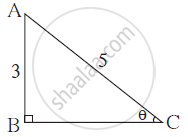
From the figure find the value of sinθ.
Write the value of \[\cot^2 \theta - \frac{1}{\sin^2 \theta}\]
Write 'True' or 'False' and justify your answer in the following:
\[\cos \theta = \frac{a^2 + b^2}{2ab}\], where a and b are two distinct numbers such that ab > 0.
Prove the following identity :
`(1 + cosA)/(1 - cosA) = (cosecA + cotA)^2`
If m = a secA + b tanA and n = a tanA + b secA , prove that m2 - n2 = a2 - b2
If sinA + cosA = m and secA + cosecA = n , prove that n(m2 - 1) = 2m
If sec θ + tan θ = m, show that `(m^2 - 1)/(m^2 + 1) = sin theta`
Prove that sin4θ - cos4θ = sin2θ - cos2θ
= 2sin2θ - 1
= 1 - 2 cos2θ
Prove that cos θ sin (90° - θ) + sin θ cos (90° - θ) = 1.
sin2θ + sin2(90 – θ) = ?
Prove that cos2θ . (1 + tan2θ) = 1. Complete the activity given below.
Activity:
L.H.S. = `square`
= `cos^2θ xx square` ...`[1 + tan^2θ = square]`
= `(cos θ xx square)^2`
= 12
= 1
= R.H.S.
If `cos θ = 24/25`, then sin θ = ?
Prove that `(cosθ)/(1 + sinθ) = (1 - sinθ)/(cosθ)`.
If `tan θ = 7/24`, then to find value of cos θ complete the activity given below.
Activity:
sec2θ = 1 + `square` ...[Fundamental tri. identity]
sec2θ = 1 + `square^2`
sec2θ = 1 + `square/576`
sec2θ = `square/576`
sec θ = `square`
cos θ = `square` ...`[cos theta = 1/sectheta]`
Prove that sin2A . tan A + cos2A . cot A + 2 sin A . cos A = tan A + cot A.
Prove that (1 – cos2A) . sec2B + tan2B (1 – sin2A) = sin2A + tan2B.
tan θ × `sqrt(1 - sin^2 θ)` is equal to:
