Advertisements
Advertisements
प्रश्न
Prove the following by using the principle of mathematical induction for all n ∈ N: `1/2 + 1/4 + 1/8 + ... + 1/2^n = 1 - 1/2^n`
Advertisements
उत्तर
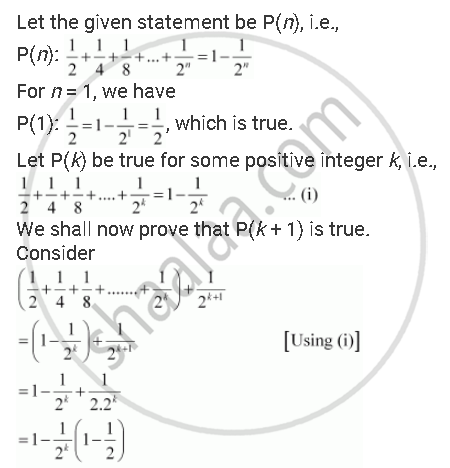
`= 1 - 1/2^k(1/2)`
`= 1 - 1/(2^(k + 1))`
Thus, P(k + 1) is true whenever P(k) is true.
Hence, by the principle of mathematical induction, statement P(n) is true for all natural numbers i.e., n.
संबंधित प्रश्न
Prove the following by using the principle of mathematical induction for all n ∈ N:
Prove the following by using the principle of mathematical induction for all n ∈ N: `1+2+ 3+...+n<1/8(2n +1)^2`
Prove the following by using the principle of mathematical induction for all n ∈ N: n (n + 1) (n + 5) is a multiple of 3.
Prove the following by using the principle of mathematical induction for all n ∈ N: 32n + 2 – 8n– 9 is divisible by 8.
If P (n) is the statement "n2 + n is even", and if P (r) is true, then P (r + 1) is true.
Given an example of a statement P (n) such that it is true for all n ∈ N.
1 + 3 + 32 + ... + 3n−1 = \[\frac{3^n - 1}{2}\]
\[\frac{1}{1 . 2} + \frac{1}{2 . 3} + \frac{1}{3 . 4} + . . . + \frac{1}{n(n + 1)} = \frac{n}{n + 1}\]
\[\frac{1}{1 . 4} + \frac{1}{4 . 7} + \frac{1}{7 . 10} + . . . + \frac{1}{(3n - 2)(3n + 1)} = \frac{n}{3n + 1}\]
1.3 + 3.5 + 5.7 + ... + (2n − 1) (2n + 1) =\[\frac{n(4 n^2 + 6n - 1)}{3}\]
a + ar + ar2 + ... + arn−1 = \[a\left( \frac{r^n - 1}{r - 1} \right), r \neq 1\]
a + (a + d) + (a + 2d) + ... (a + (n − 1) d) = \[\frac{n}{2}\left[ 2a + (n - 1)d \right]\]
52n −1 is divisible by 24 for all n ∈ N.
n(n + 1) (n + 5) is a multiple of 3 for all n ∈ N.
11n+2 + 122n+1 is divisible by 133 for all n ∈ N.
Prove that 1 + 2 + 22 + ... + 2n = 2n+1 - 1 for all n \[\in\] N .
Answer the following:
Prove, by method of induction, for all n ∈ N
12 + 42 + 72 + ... + (3n − 2)2 = `"n"/2 (6"n"^2 - 3"n" - 1)`
Answer the following:
Prove, by method of induction, for all n ∈ N
2 + 3.2 + 4.22 + ... + (n + 1)2n–1 = n.2n
Answer the following:
Given that tn+1 = 5tn − 8, t1 = 3, prove by method of induction that tn = 5n−1 + 2
Answer the following:
Prove by method of induction loga xn = n logax, x > 0, n ∈ N
Answer the following:
Prove by method of induction 52n − 22n is divisible by 3, for all n ∈ N
A student was asked to prove a statement P(n) by induction. He proved that P(k + 1) is true whenever P(k) is true for all k > 5 ∈ N and also that P(5) is true. On the basis of this he could conclude that P(n) is true ______.
State whether the following proof (by mathematical induction) is true or false for the statement.
P(n): 12 + 22 + ... + n2 = `(n(n + 1) (2n + 1))/6`
Proof By the Principle of Mathematical induction, P(n) is true for n = 1,
12 = 1 = `(1(1 + 1)(2*1 + 1))/6`. Again for some k ≥ 1, k2 = `(k(k + 1)(2k + 1))/6`. Now we prove that
(k + 1)2 = `((k + 1)((k + 1) + 1)(2(k + 1) + 1))/6`
Prove the statement by using the Principle of Mathematical Induction:
4n – 1 is divisible by 3, for each natural number n.
Prove the statement by using the Principle of Mathematical Induction:
n3 – 7n + 3 is divisible by 3, for all natural numbers n.
Prove the statement by using the Principle of Mathematical Induction:
`sqrt(n) < 1/sqrt(1) + 1/sqrt(2) + ... + 1/sqrt(n)`, for all natural numbers n ≥ 2.
A sequence d1, d2, d3 ... is defined by letting d1 = 2 and dk = `(d_(k - 1))/"k"` for all natural numbers, k ≥ 2. Show that dn = `2/(n!)` for all n ∈ N.
Prove that number of subsets of a set containing n distinct elements is 2n, for all n ∈ N.
If 10n + 3.4n+2 + k is divisible by 9 for all n ∈ N, then the least positive integral value of k is ______.
For all n ∈ N, 3.52n+1 + 23n+1 is divisible by ______.
If xn – 1 is divisible by x – k, then the least positive integral value of k is ______.
If P(n): 2n < n!, n ∈ N, then P(n) is true for all n ≥ ______.
