Advertisements
Advertisements
प्रश्न
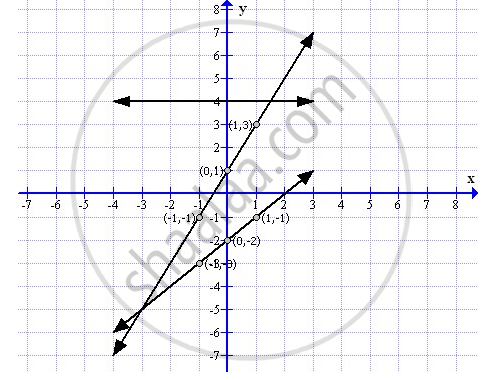
On the same graph paper, plot the graph of y = x - 2, y = 2x + 1 and y = 4 from x= - 4 to 3.
Advertisements
उत्तर
First, prepare a table as follows:
| X | -1 | 0 | 1 |
| Y = x - 2 | -3 | -2 | -1 |
| Y = 2x + 1 | -1 | 1 | 3 |
| Y = 4 | 4 | 4 | 4 |
Now the graph can be drawn as follows:
APPEARS IN
संबंधित प्रश्न
Draw the graph of the equation given below.
x + y = 2
The following distribution gives the daily income of 50 workers of a factory.
| Daily income (in ₹) | 200-220 | 220-240 | 240-260 | 260-280 | 280-300 |
| Number of workers | 12 | 14 | 8 | 6 | 10 |
Convert the distribution above to a 'less than type' cumulative frequency distribution and draw its ogive.
Draw the graph for the linear equation given below:
x = 3
Draw the graph for the linear equation given below:
x + 3 = 0
Draw the graph for the linear equation given below:
x - 5 = 0
Draw the graph for the linear equation given below:
2y - 5 = 0
Draw the graph for the linear equation given below:
y = `(2x)/(3) - 1`
For the pair of linear equations given below, draw graphs and then state, whether the lines drawn are parallel or perpendicular to each other.
y = x - 3
y = - x + 5
On the same graph paper, plot the graphs of y = 2x - 1, y = 2x and y = 2x + 1 from x = - 2 to x = 4. Are the graphs (lines) drawn parallel to each other?
Draw a graph of each of the following equations: 2(x - 5) = `(3)/(4)(y - 1)`
