Advertisements
Advertisements
प्रश्न
Name the following.
The persons to whom Kailash Satyarthi gives the highest credit of his honour - ____________.
Advertisements
उत्तर
The persons to whom Kailash Satyarthi gives the highest credit of his honour - Kalu Kumar, Dhoom das, Adarsh Kishore and Iqbal Masih.
APPEARS IN
संबंधित प्रश्न
Put a ✓or ×.
A good speech delivered requires the following characteristics.
Well planned and thoughts well-organized.
Put a ✓or ×.
A good speech delivered requires the following characteristics.
Delivered softly and in a low voice.
Put a ✓or ×.
A good speech delivered requires the following characteristics.
Language used should be suitable for the audience.
With the help of your teacher and classmates make a list of as many Indian Nobel Laureates as you can. (You can use the Internet or school library.)
| Name | Nobel Prize for |
| ________________________ | ________________________ |
| ________________________ | ________________________ |
| ________________________ | ________________________ |
| ________________________ | ________________________ |
Name the following.
The foreign activists of equal rights, mentioned in the speech - ______.
Think and give your own response.
How can education help deprived children and child labourers?
Write any 2 efforts that you can make to enroll deprived children/ out of school children into a school. One is given to you.
(a) I will persuade parents of such children to send them to school.
(b) _________________________________________________
(c) _________________________________________________
Mention the social issues highlighted by Kailash Satyarthi in his speech. One social issue is given for you.
- Child labour
- ____________
- ____________
- ____________
- ____________
Write any 2 efforts that you can make to enroll deprived children/out of school children into a school. One is given for you.
- I will persuade parents of such children to send them to school.
- __________________
- __________________
- __________________
- __________________
Read the following passage and do the activities:
B1. Who said to whom? (2)
| Sentence | Who said | To whom | |
| i. | Is the world so poor that it cannot give me a toy and a book? | ||
| ii. | What is my fault? |
|
Twenty years ago, in the foothills of the Himalayas, I met a small, skinny child labourer. He asked me : “Is the world so poor that it cannot give me a toy and a book instead of forcing me to take a gun or a tool?” I met with a Sudanese child soldier. He was kidnapped by an extremist militia. As his first training lesson, he was forced to kill his friends and family. He asked me: “What is my fault?” Friends, all the great religions teach us to care for our children. Jesus said: “Let the children come to me; do not hinder them, for the kingdom of God belongs to them.” The Holy Quran says: “Kill not your children because of poverty.” Friends! There is no greater violence than to deny the dreams of our children. Therefore ... I refuse to accept that all the temples and mosques and churches and prayer houses have no place for the dreams of our children. I refuse to accept that the world is so poor, when just one week of global military expenditure can bring all the children to classrooms. |
B2. Complete the web: (2)
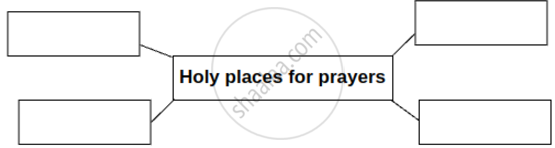
B3. Write the describing words for the following from the passage: (2)
| i. | ____________ | Week |
| ii. | ____________ | Quaran |
| iii. | ____________ | Violence |
| iv. | ____________ | religions |
B4. Do as Directed: (2)
- He asked me, “What is my fault?” (Choose the correct indirect speech from the following)
- He asked me what is his fault.
- He asked me what was his fault.
- He asked me what his fault is.
- He asked me what his fault was.
- He was forced to kill his friends and family.
(Rewrite the sentence and underline the infinitive)
B5. Personal Response: (2)
What will you do if you find a poor and needy child? Explain.
