Advertisements
Advertisements
प्रश्न
Mention the social issues highlighted by Kailash Satyarthi in his speech. One social issue is given for you.
- Child labour
- ____________
- ____________
- ____________
- ____________
Advertisements
उत्तर
Social issues highlighted by Kailash Satyarthi are:
- Child labour
- Slavery
- Trafficking
- Child marriage
- Sexual abuse
- Illiteracy
APPEARS IN
संबंधित प्रश्न
Observe the pictures and answer.
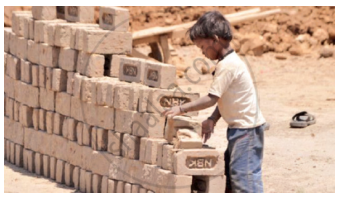 |
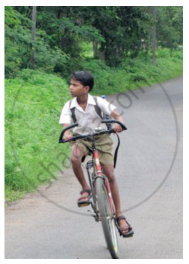 |
- Main difference between the two images
- Change required
- Your contribution as a student to help and make a difference to needy children.
Put a right or wrong
A good speech delivered requires the following characteristic.
Well planned and thoughts well-organized.
Put a right or wrong
A good speech delivered requires the following characteristic.
Delivered softly and in a low voice.
Put a right or wrong
A good speech delivered requires the following characteristic.
Speech should be of a proper duration.
Put a right or wrong
A good speech delivered requires the following characteristic.
Speaker should be passive, and have no facial expressions.
Put a right or wrong
A good speech delivered requires the following characteristic.
Speech should be supported by good examples/episodes/visual aids. (where possible)
Name the following.
The persons to whom Kailash Satyarthi gives the highest credit of his honour.
Name the following.
The greatest personalities from the land of Buddha
Name the following.
The foreign activists of equal rights, mentioned in the speech
Complete the following diagram/chart.
| The aim in life of Kailash Satyarthi is that every child should be free..... | → | to..... |
| → | to..... | |
| → | to..... | |
| → | to..... | |
| → | to..... | |
| → | to..... | |
| → | to..... |
Complete the following web-chart.
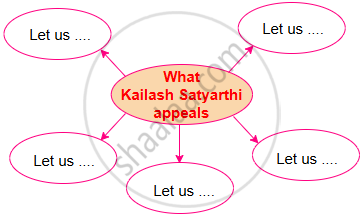
Think and give your own response.
Besides the political freedom that our nation enjoys, what other freedom should it strive for? Say why.
Think and give your own response.
What is your impression of the acceptance speech given by Kailash Satyarthi, when he received the Nobel Prize? Write in 3 to 4 sentences.
Think and give your own response.
Name any other social activist who has worked/is working earnestly for child-welfare. Write about his/her activities.
What will you do in the following situation?
If you find a child working at a brickwork site.
What will you do in the following situation?
If you come across a beggar child.
Write any 2 efforts that you can make to enrol deprived children/out of school children into a school. One is given for you.
- I will persuade parents of such children to send them to school.
 |
 |
Discuss in your group.
- What difference do you notice in the two images?
- Which of the two situations, should change?
- How and when can the situation change?
- How can you, as a student, contribute and help make a difference to the needy children?
The persons to whom Kailash Satyarthi gives the highest credit of his honour -
The greatest personalities from the land of Buddha -
The ‘Daughters’ of Kailash Satyarthi mentioned in his speech -
The foreign activists of equal rights, mentioned in the speech -
Complete the following diagram/chart.
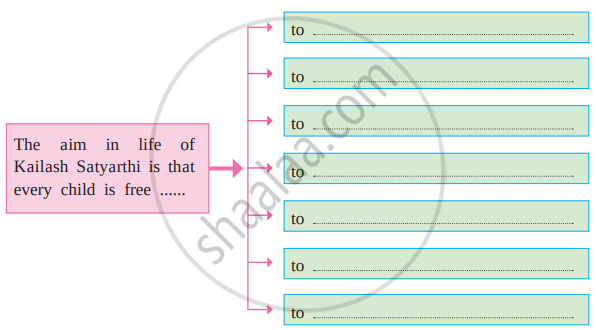
Write any 2 efforts that you can make to enroll deprived children/out of school children into a school. One is given for you.
- I will persuade parents of such children to send them to school.
- __________________
- __________________
- __________________
- __________________
Today, it is time for every child to have a right to -
education, _______, _______, _______, _______, _______, _______, _______, _______.
Make a list of Indian Nobel Laureates.
- ____________
- ____________
- ____________
Make a list of prestigious awards in India.
| Civilian Awards | Highest Gallantry Awards |
| (a) Bharat Ratna | (a) Paramveer Chakra |
| (b) | (b) |
| (c) | (c) |
| (d) | (d) |
| (e) | (e) |
Read the passage carefully and complete the activities: [10]
B1. Complete the following sentences. [2]
- Let us march from ignorance ______.
- Kailash Satyarthi says that today he sees thousands of ______.
- Close your eyes and feel ______.
- Let us universalise ______.
B2. Complete the following web. [2]
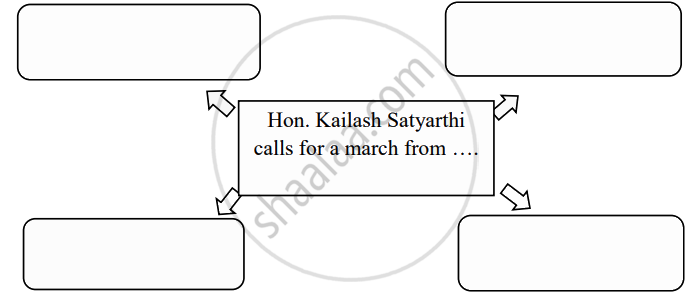
|
TODAY, beyond the darkness, I see the smiling faces of our children in the blinking stars. TODAY, in every wave of every ocean, I see my children are playing and dancing. TODAY, in every plant, in every tree, and mountain, I see our children growing freely with dignity. Friends, I want you to see and feel this TODAY inside you. I am sure you can - Now, listen to that child. Listen, please. |
B3. Write the noun forms of the following from the passage. [2]
- dark - ______
- exploit - ______
- educate - ______
- ignore - ______
B4. Do as directed. [2]
- Let us democratise knowledge. (choose the correct question tag and rewrite the sentence using it)
- will you?
- shall we?
- Isn’t it?
- wasn’t it?
- May I please request you to put your hand close to your heart?
(underline the ‘infinitive’)
B5. Personal Response: [2]
What does honourable Kailash Satyarthi suggest us to do?
