Advertisements
Advertisements
प्रश्न
Name the following halide according to the IUPAC system and classify it as an alkyl, allyl, benzoyl (primary, secondary, tertiary), vinyl or aryl halide:
CH3CH2CH(CH3)CH(C2H5)Cl
Advertisements
उत्तर
\[\begin{array}{cc}
\ce{CH3}\phantom{...}\ce{Cl}\phantom{.}\\
|\phantom{.........}|\phantom{..}\\
\ce{CH3 - CH2 - CH - CH - CH2 - CH3}\\
\end{array}\]
IUPAC Name: 3-chloro-4-methylhexane
Classification: Secondary (2°) alkyl halide
APPEARS IN
संबंधित प्रश्न
Draw the structure of the major monohalo product in the following reaction:

Draw the structure of the major monohalo product in the following reaction:

Match the items of Column I and Column II.
| Column I | Column II | |
| (i) | SN1 reaction | (a) vic-dibromides |
| (ii) | Chemicals in fire extinguisher | (b) gem-dihalides |
| (iii) | Bromination of alkenes | (c) Racemisation |
| (iv) | Alkylidene halides | (d) Saytzeff rule |
| (v) | Elimination of HX from alkylhalide | (e) Chlorobromocarbons |
Which of the following belongs to the class of vinyl halides?
Name the following halide according to the IUPAC system and classify it as alkyl, allyl, benzyl (primary, secondary, tertiary), vinyl or aryl halide:
\[\ce{CH_3CH_2C(CH_3)_2CH_2I}\]
Name the following halide according to the IUPAC system and classify it as alkyl, allyl, benzyl (primary, secondary, tertiary), vinyl, or aryl halide:
\[\ce{CH3C(C2H5)2CH2Br}\]
Name the following halide according to IUPAC system and classify them as alkyl, allyl, benzyl (primary, secondary, tertiary), vinyl or aryl halides:
\[\ce{CH3C(C2H5)2CH2Br}\]
Name the following halide according to IUPAC system and classify them as alkyl, allyl, benzyl (primary, secondary, tertiary), vinyl or aryl halides:
\[\ce{CH3 CH2 C(CH3)2 CH2I}\]
Name the following halide according to IUPAC system and classify them as alkyl, allyl, benzyl (primary, secondary, tertiary), vinyl or aryl halides:
\[\ce{CH3C(C2H5)2CH2Br}\]
Name the following halide according to IUPAC system and classify it as alkyl, allyl, benzyl (primary, secondary, tertiary), vinyl or aryl halides:
\[\ce{CH3C(Cl)(C2H5)CH2CH3}\]
Name the following halide according to IUPAC system and classify them as alkyl, allyl, benzyl (primary, secondary, tertiary), vinyl or aryl halide:
\[\ce{CH3C(CI)(C2H5)CH2CH3}\]
Name the following halide according to IUPAC system and classify them as alkyl, allyl, benzyl (primary, secondary, tertiary), vinyl or aryl halides.
\[\ce{CH3CH2C(CH3)2CH2I}\]
Name the following halide according to IUPAC system and classify as alkyl, allyl, benzyl (primary, secondary, tertiary), vinyl or aryl halides:
\[\ce{CH3C(C2H5)2CH2Br}\]
Write the structure of the following organic halogen compound.
4-tert-Butyl-3-iodoheptane
IUPAC name of \[\begin{array}{cc}
\phantom{}\ce{CH3}\phantom{..........}\ce{Br}\phantom{........}\\
\phantom{}|\phantom{................}|\phantom{.........}\\
\phantom{}\ce{CH3CHCH2CHCHCH2CH3}\phantom{}\\
\phantom{}|\phantom{..}\\
\phantom{..}\ce{CH3}\phantom{}
\end{array}\] is ______.
IUPAC name of 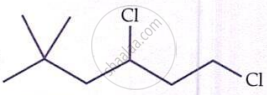 is ______.
Ethylidene chloride is a/an ______.
