Advertisements
Advertisements
प्रश्न
Name the different types of Chromatography and explain the principles underlying them.
Advertisements
उत्तर
Depending on the nature of the stationary phase i.e., whether it is a solid or a liquid, chromatography is classified into adsorption chromatography and partition chromatography.
- Adsorption chromatography: This technique is based on the principle of differential adsorption. Different solutes are adsorbed on an adsorbent to a different extent.
Adsorption chromatography is further classified into two types:
a. Column chromatography
b. Thin-layer chromatography - Partition chromatography: This technique is based on the continuous differential partitioning of components of a mixture between stationary and mobile phases. For example, paper chromatography.
APPEARS IN
संबंधित प्रश्न
Explain the principle of paper chromatography.
What is chromatography?
What are the advantages of chromatography?
Name the simplest type of chromatography?
What is meant by stationary phase and mobile phase in chromatography?
Give a scientific reason.
In chromatography, the ingredients of a mixture rise up to limited height water rises up to the upper end of the paper.
State the correct technique for the separation of the following mixture.
solid constituents in a liquid constituent by adsorption.
Dyes of an ink
- Give the principle involved in the separation of the mixture
- Give the technique of separation of the mixture.
Give a reason for the following statement:
In chromatography the absorbent medium e.g. What man filter paper is known as the stationary phase.
Choose the correct option.
Colourless components on chromatogram can not be observed by the following:
Give names of two materials used as stationary phase in chromatography.
Define the Stationary phase.
How do you visualize colourless compounds after separation in TLC and Paper Chromatography?
Compare TLC and Paper Chromatography techniques.
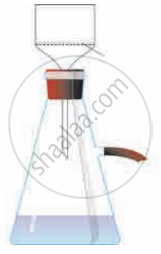
Label the diagram and explain the process in your words.
Chromatography is based on the principle of ______.
What is paper chromatography?
Paper chromatography is ______.
The separation of two coloured substances was done by paper chromatography. The distances travelled by solvent front, substance A and substance B from the baseline are 3.25 cm, 2.08 cm and 1.05 cm respectively. The ratio of Rf values of A to B is ______.
In chromatography, which of the following statement is INCORRECT for Rf?
Complex mixtures are separated by ______.
Which basic principle is used in chromatography?
