Advertisements
Advertisements
प्रश्न
Name the following:
A metallic oxide which can be reduced into metal by hydrogen.
Advertisements
उत्तर
Copper oxide (CuO)
APPEARS IN
संबंधित प्रश्न
Indicate which of the following statement is true and which is false:
Zinc can liberate hydrogen from water, acid and alkali solution.
Name the following:
A metal which liberates hydrogen only when steam is passed over red hot metal.
Name the chemicals required to prepare hydrogen gas in the laboratory.
Draw a neat and well-labelled diagram for the laboratory preparation of hydrogen.
Under what conditions can hydrogen be made to combine with chlorine?
Name the products and write the equation for the reaction.
Starting from zinc how would you obtain hydrogen using Steam.
[Give balanced equation & name the product formed in the case other than hydrogen].
Name a metal which will not react with the reactants above to give hydrogen.
Starting from zinc how would you obtain hydrogen using a dilute acid.
[Give balanced equation & name the product formed in the case other than hydrogen].
Name a metal which will not react with the reactants above to give hydrogen.
In the laboratory preparation of hydrogen from zinc & dilute hydrocholoric acid – state a reason for the collecting the hydrogen by downward displacement of water and not air & collecting it after all the air in the apparatus is allowed to escape.
Give balanced equation for the following conversion:
Zinc to sodium zincate – using an alkali.
Give reason for the following:
In the laboratory preparation of hydrogen from zinc and dilute hydrochloric acid – the zinc used granulated zinc.
Give a balanced equation for the following conversions sodium aluminate from aluminium.
In the laboratory preparation of hydrogen from zinc and dil. acid. Give a reason for the following:
Dilute nitric acid is not preferred as the reactant acid.
In the laboratory preparation of hydrogen from zinc and dil. acid. Give a reason for the following:
Hydrogen is not collected over air.
Name the following.
A gaseous reducing agent which is basic in nature.
Select the correct answer from the symbol in the bracket.
The element which forms a diatomic molecule.
The diagram represent the preparation and collection of hydrogen by a standard laboratory method.
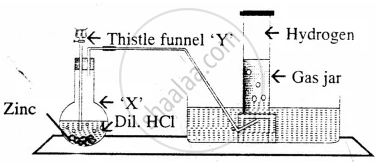
Name a solution which absorbs the impurity – `"H"_2"S"`
The diagram represent the preparation and collection of hydrogen by a standard laboratory method.
Name a gas other than hydrogen collected by the same method.
