Advertisements
Advertisements
प्रश्न
Name the following:
A metal which liberates hydrogen only when steam is passed over red hot metal.
Advertisements
उत्तर
Iron
APPEARS IN
संबंधित प्रश्न
Name the following:
A metallic oxide which can be reduced into metal by hydrogen.
Name the chemicals required to prepare hydrogen gas in the laboratory.
FILL IN THE BLANK
Sodium liberates hydrogen when treated with cold .............
Why is granulated zinc preferred in the laboratory preparation of hydrogen?
Give a test to identify hydrogen ?
Under what conditions can hydrogen be made to combine with chlorine?
Name the products and write the equation for the reaction.
How would you show that hydrogen is lighter than air?
Starting from zinc how would you obtain hydrogen using an alkali.
[Give balanced equation & name the product formed in the case other than hydrogen].
Name a metal which will not react with the reactants above to give hydrogen.
In the laboratory preparation of hydrogen from zinc & dilute hydrocholoric acid – state a reason for the addition of traces of copper [II] sulphate to the reaction medium.
In the laboratory preparation of hydrogen from zinc & dilute hydrocholoric acid – state a reason for the collecting the hydrogen by downward displacement of water and not air & collecting it after all the air in the apparatus is allowed to escape.
Draw neat labelled diagrams for two different experiments to prove that – hydrogen is lighter than air.
Give balanced equation for the following conversion:
Zinc to sodium zincate – using an alkali.
Give balanced equation for the following conversion:
Acidified water to hydrogen – by electrolysis.
Complete and balance the equation:
[Laboratory method]
By action of dilute acid on zinc
Zinc - Zn + 2HCl → _____ + _____ [g]
Give a balanced equation for the following conversions sodium plumbite from lead.
Give a balanced equation for the following conversions sodium aluminate from aluminium.
In the laboratory preparation of hydrogen from zinc and dil. acid. Give a reason for the following:
The complete apparatus is air-tight.
The diagram represent the preparation and collection of hydrogen by a standard laboratory method.
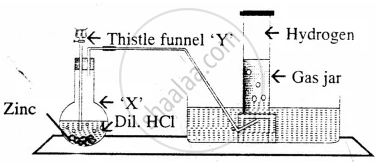
State, why hydrogen is collected after all the air in the apparatus, is allowed to escape.
