Advertisements
Advertisements
प्रश्न
Mention whether the following statement is true (T) or false (F) and give an explanation in support of your answer.
Soaked seeds burst into three seed coats.
Mention whether the following statement is true (T) or false (F) and give an explanation in support of your answer.
Soaked seeds burst their seed coats.
पर्याय
True
False
Advertisements
उत्तर
This statement is true.
Explanation:
Yes, it is true that soaked seeds burst into three seed coat layers for germination. In some plants, the surface layer, middle layer, and inner layer make up a three-layered seed coat. So, when they are soaked in water, water is imbibed into the seeds and the seeds swell up, exerting pressure on the seed coat and burst the seed coats.
APPEARS IN
संबंधित प्रश्न
The state of a cell in which the cell wall is rigid and stretched by the increase in volume due to the absorption of water is called.
Give the equivalent term for the following:
The condition in which the cell contents are shrunken.
Differentiate between the following:
Turgor pressure and wall pressure
Give reason for the following:
It is better to transplant seedlings in a flower-bed in the evening and not in the morning.
The below diagram represents a plant cell after being placed in a strong sugar solution. Guidelines 1 to 5 indicate the following: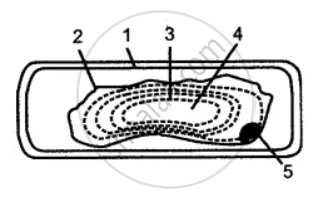
1. Cell wall
2. Plasma membrane.
3. Protoplasm
4. Large vacuole
5. Nucleus
Study the diagram and answer the questions that follow :
(i) What is the state of the cell shown in the diagram?
(ii) Name the structure which acts as a selectively permeable membrane.
(iii) If the cell had been placed in distilled water instead of a strong sugar solution which features: would not have been present?
(iv) If the cell in the diagram possessed chloroplasts where would these be present?
(v) Name any one feature of this plant cell which is not present in animal cells.
Give Technical Term for the following.
The pressure exerted by cell contents on a plant cell wall.
Deplasmolysis occurs when a plasmolysed cell is placed in ______.
When the cells of a plant are fully distended, the condition is called ______.
Addition of salt to pickles is a method of killing the bacteria by ______.
Give the equivalent term for the following:
Pressure exerted by the cell contents on the cell wall.
