Advertisements
Advertisements
प्रश्न
The below diagram represents a plant cell after being placed in a strong sugar solution. Guidelines 1 to 5 indicate the following: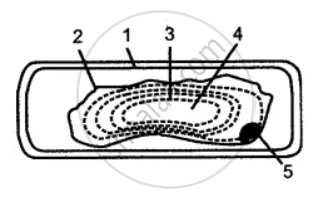
1. Cell wall
2. Plasma membrane.
3. Protoplasm
4. Large vacuole
5. Nucleus
Study the diagram and answer the questions that follow :
(i) What is the state of the cell shown in the diagram?
(ii) Name the structure which acts as a selectively permeable membrane.
(iii) If the cell had been placed in distilled water instead of a strong sugar solution which features: would not have been present?
(iv) If the cell in the diagram possessed chloroplasts where would these be present?
(v) Name any one feature of this plant cell which is not present in animal cells.
Advertisements
उत्तर
(i) Flaccid.
(ii) Plasma membrane.
(iii) If the cell had been placed in distilled water it remains in a fully distended condition. Its plasma membrane remains in close contact with the cell wall and presses against it.
(iv) Chloroplast will be present in the protoplasm outside the vacuole.
(v) Cell wall.
संबंधित प्रश्न
The diagram given below represents a plant cell after being placed in a strong sugar solution. Study the diagram and answer the questions that follow:

- What is the state of the cell shown in the diagram?
- Name the structure that acts as a selectively permeable membrane.
- Label the parts numbered 1 to 4 in the diagram.
- How can the above cell be brought back to its original condition? Mention the scientific term for the recovery of the cell.
- State any two features of the above plant cell which is not present in animal cells.
A plant cell may burst when :
Explain Turgor pressure
Give reason for the following:
A plant cell, when kept in a hypertonic salt solution for about 30 minutes, turns flaccid.
A leaf cell of a water plant was placed in a liquid other than pond water. After sometime, it assumed a shape as shown below:
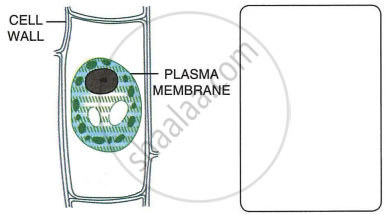
- Give the term for the state of the cell it has acquired.
- Name the structure which acts as a selectively permeable membrane.
- Comment on the nature (tonicity) of the liquid surrounding the cell.
- Name any one feature of this plant cell which is not present in an animal cell.
- Redraw in the space provided, the diagram of the cell if it is soon placed in ordinary water for some time.
Give Technical Term for the following.
The pressure exerted by cell contents on a plant cell wall.
Name the following:
The process by which wilting or drooping of leaves occurs.
Multiple Choice Question:
When cell is fully turgid, which of the following will be zero?
The hydrostatic pressure of the cell sap on the cell wall is called ______.
