Advertisements
Advertisements
प्रश्न
Integrate the functions `(sin^(-1) sqrtx - cos^(-1) sqrtx)/ (sin^(-1) sqrtx + cos^(-1) sqrtx) , x in [0,1]`
Advertisements
उत्तर
Let I=∫sin-1x-cos-1xsin-1x+cos-1xdx
It is known that, sin-1x+cos-1x=π2
⇒I=∫π2-cos-1x-cos-1xπ2dx
=2π∫π2-2cos-1xdx
=2π.π2∫1.dx-4π∫cos-1xdx
=x-4π∫cos-1xdx ...(1)
Let I1=∫cos-1x dx
Also, let x=t⇒dx=2 t dt
⇒I1=2∫cos-1t.t dt
=2cos-1t.t22-∫-11-t2.t22dt
=t2cos-1t+∫t21-t2dt
=t2cos-1t-∫1-t2-11-t2dt
=t2cos-1t-∫1-t2dt+∫11-t2dt
=t2cos-1t-t21-t2-12sin-1t+sin-1t
=t2cos-1t-t21-t2+12sin-1t
From equation (1), we obtain
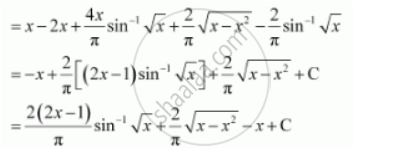
I=x-4πt2cos-1t-t21-t2+12sin-1t =x-4πxcos-1x-x21-x+12sin-1x
=x-4πxπ2-sin-1x-x-x22+12sin-1x
APPEARS IN
संबंधित प्रश्न
Find :`int(x^2+x+1)/((x^2+1)(x+2))dx`
If `f(x) =∫_0^xt sin t dt` , then write the value of f ' (x).
Find an anti derivative (or integral) of the following function by the method of inspection.
Cos 3x
Find an anti derivative (or integral) of the following function by the method of inspection.
e2x
Find an antiderivative (or integral) of the following function by the method of inspection.
sin 2x – 4 e3x
Find the following integrals:
`int (ax^2 + bx + c) dx`
Find the following integrals:
`int (x^3 + 3x + 4)/sqrtx dx`
Find the following integrals:
`int(2x - 3cos x + e^x) dx`
Find the following integrals:
`intsec x (sec x + tan x) dx`
The anti derivative of `(sqrtx + 1/ sqrtx)` equals:
Integrate the function:
`1/(sqrt(x+a) + sqrt(x+b))`
Integrate the function:
`1/(x^2(x^4 + 1)^(3/4))`
Integrate the function:
`1/(x^(1/2) + x^(1/3)) ["Hint:" 1/(x^(1/2) + x^(1/3)) = 1/(x^(1/3)(1+x^(1/6))), "put x" = t^6]`
Integrate the function:
`e^x/((1+e^x)(2+e^x))`
Integrate the function:
`cos^3 xe^(log sinx)`
Integrate the function:
`1/sqrt(sin^3 x sin(x + alpha))`
Integrate the function:
`(x^2 + x + 1)/((x + 1)^2 (x + 2))`
Evaluate: `int (1 - cos x)/(cos x(1 + cos x)) dx`
If `d/(dx) f(x) = 4x^3 - 3/x^4`, such that `f(2) = 0`, then `f(x)` is
`int (dx)/sqrt(9x - 4x^2)` equals
`int (xdx)/((x - 1)(x - 2))` equals
`int e^x sec x(1 + tanx) dx` equals
If y = `x^((sinx)^(x^((sinx)^(x^(...∞)`, then `(dy)/(dx)` at x = `π/2` is equal to ______.
What is integration called because it reverses the operation of finding derivatives?
In \[\int f(x)\,dx\], what is \(f(x)\) called?
What is “an integral of \(f\)” ?
What is integration?
What is \(C\) called in \[\int f(x)\,dx=F(x)+C\]?
Which statement about indefinite integrals is correct?
Which antiderivative has derivative \(1\)?
Evaluate \[\int \text{cosec} x\cot x\,dx\]
Which expression is also an antiderivative of \[\frac{1}{\sqrt{1-x^2}}\]?
Evaluate \[\int \frac{dx}{1+x^2}\]
Evaluate \[\int \frac{1}{x}\,dx\]
