Advertisements
Advertisements
प्रश्न
Instructions for Question: Read the information given below to answer the question.
A, B, C, D, E, F, G, and H want to have dinner on a round table and they have worked out the following seating arrangements.
(a) A will sit beside C.
(b) H will sit beside A.
(c) C will sit beside E.
(d) F will sit beside H.
(e) E will sit beside G.
(f) D will sit beside F.
(g) G will sit beside B.
(h) B will sit beside D.
H will be sitting between:
पर्याय
C and B
A and F
D and C
E and G
Advertisements
उत्तर
A and F
Explanation:
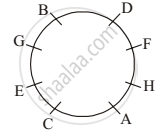
APPEARS IN
संबंधित प्रश्न
Find the odd one out :
Onlookers, Theatre goers, Queue, Spectators
Instructions for Question: Read the information given below to answer the question.
(i) Mohan‘s reading schedule consists of reading only subject on a given day of the week.
(ii) The subjects are Physics, Chemistry, Mathematics, Biology, and Social Science.
(iii) Monday to Saturday are reading days including one day only for play. Sunday is a complete holiday for Mohan.
(iv) Mathematics day is neither on the first day nor on the last day but earlier than the Chemistry day.
(v) Biology day is on the immediate next day of Chemistry day.
(vi) Physics day is on the immediate previous day of the play day. (vii) Biology day and Social Science day have a gap of two days between them.
(viii) Social Science day is on the immediate next day of the play day.
Which of the following is the correct statement?
Recently, the answers to a test held nationwide were leaked to a group of unscrupulous people. The investigative agency has arrested the mastermind and nine other people A, B, C. D, E, F, G, H and I in this matter. Interrogating them, the following facts have been obtained regarding their operation. Initially, the mastermind obtains the correct answer key. All the others create their answer key from one or two people who already possess the same. These people are called his/her "sources".
If the person has two sources, then he/she compares the answer keys obtained for both sources. If the key to a question from both sources is identical, it is copied, otherwise it is left blank.
If the person has only one source, He/she copies the source's answer into his/her copy. Finally, each person compulsorily replaces one of the answers (not a blank one) with a wrong answer in his/her answer key.
The paper contained 200 questions, so the investigative agency has ruled out the possibility of two or more of them introducing wrong answers to the same question. The investigative agency has a copy of the correct answer key and has tabulated the following data. This data represents question numbers.
| Name | Wrong Answer(s) | Blank Answer(s) |
| A | 45 | - |
| B | 96 | 46,90,25 |
| C | 2756 | 17,46,90 |
| D | 17 | - |
| E | 4690 | - |
| F | 1446 | 92,90 |
| G | 25 | - |
| H | 4692 | - |
| I | 27 | 17,26,90 |
Both G and H were sources to
Choose the most appropriate option:
If Oceans are Deserts, then Waves are:
Choose the most appropriate option:
If it is false that 'Animals are seldom aggressive', then which one of the following statements conveys the same meaning?
Read the following information carefully and choose the appropriate option in the questions given below:
i. There is a group of five persons – A, B, C, D and E.
ii. One of them is a Singer, one is a Dancer, one is a Painter, one is a teacher and one is a Doctor.
iii. Three of them – A, C and Doctor prefer rice to chapatti and two of them – B and the Painter prefer chapatti to rice.
iv. The Teacher, D and A are friends to one another but two of these prefer chapatti to rice.
v. The Singer is C’s brother.
Who is a Singer?
The doctor is a person who looks after the sick people and prescribes medicines so that the patient recovers fast. In order to become a doctor, a person has to study medicine. Doctors lead a hard life. Their life is very busy. They get up early in the morning and go to the hospital. They work without taking a break. They always remain polite so that patients feel comfortable with them. Since doctors work so hard we must realise their value.
Based on the above paragraph, who among the following is/are doctor(s)?
i. Kumar Sharma wakes up early in the morning every day and treats everyone with patience. He usually gives emergency aid to the persons who are injured in accidents. ii. Rakesh studied medicine in Russia and practiced medicine there for 2 years. Later, stopped medical practice and turned into some business.
iii. Shalini works in Apollo Hospitals. She always remains polite so that patients feel comfortable. She is a specialist in providing quality care for cancer patients.
College : Student :: Hospital : ?
The following question, two statements are given followed by two or three Conclusions I, II, and III. You have to consider the two statements to be true even if they seem to be at variance from commonly known facts. You have to decide which of the given conclusions if any follow from the given statements
Statements
- Education is a process of lighting.
- The mind requires light to enlighten the core of the cognitive aspect.
Conclusions
- Education is a light that removes the darkness of the mind.
- Education is a static process for the mind.
The question below is given a statement followed by three courses of action numbered I, II, and ill. A course of action is a step or administrative decision to be taken for improvement, follow-up, or further action in regard to the problem, policy, etc. On the basis of information given in the statement, you have to assume everything in the statement to be true and then decide which of the three given suggested courses of action logically follows worth pursuing. Then, decide which of the alternatives (a), (b), (c), or (d) is correct.
Statement A large private bank has decided to retrench one-third of its employees in view of the huge losses incurred by it during the past three quarters.
Courses of Action
I. The Government should issue a notification to the general public to immediately stop all transactions with the bank.
II. The Government should direct the bank to refrain from retrenching its employees.
III. The Government should ask the central bank of the country to initiate an inquiry into the bank's activities and submit its report.
