Advertisements
Advertisements
प्रश्न
In Young's double slit experiment, plot a graph showing the variation of fringe width versus the distance of the screen from the plane of the slits keeping other parameters same. What information can one obtain from the slope of the curve?
Advertisements
उत्तर
The fringe width in Young's double slit experiment is given by
β=λD/d/
whereλ=Wavelength of source
D=Distance between the slits and screen
d=Distance between the slits
⇒β∝D
The variation of fringe width with distance of screen from the slits is given by the graph shown below:
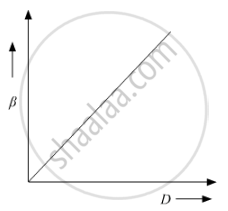
It is a linear graph with slope equal to λ/d. So, for the fringe width to vary linearly with distance of screen from the slits, the ratio of wavelength to distance between the slits should remain constant. Therefore, it is advised to take wavelengths of incident light nearly equal to the width of the slit.
APPEARS IN
संबंधित प्रश्न
In a double-slit experiment using the light of wavelength 600 nm, the angular width of the fringe formed on a distant screen is 0.1°. Find the spacing between the two slits.
If the separation between the slits in a Young's double slit experiment is increased, what happens to the fringe-width? If the separation is increased too much, will the fringe pattern remain detectable?
A Young's double slit apparatus has slits separated by 0⋅28 mm and a screen 48 cm away from the slits. The whole apparatus is immersed in water and the slits are illuminated by red light \[\left( \lambda = 700\text{ nm in vacuum} \right).\] Find the fringe-width of the pattern formed on the screen.
Why is the diffraction of sound waves more evident in daily experience than that of light wave?
ASSERTION (A): In an interference pattern observed in Young's double slit experiment, if the separation (d) between coherent sources as well as the distance (D) of the screen from the coherent sources both are reduced to 1/3rd, then new fringe width remains the same.
REASON (R): Fringe width is proportional to (d/D).
How will the interference pattern in Young's double-slit experiment be affected if the source slit is moved away from the plane of the slits?
The maximum number of possible interference maxima for slit-separation equal to twice the wavelength in Young's double-slit experiment is ______.
What is fringe width?
What is the fringe width \(\beta\) in Young's double-slit experiment?
What happens to fringe width when slit separation increases while wavelength and screen distance remain unchanged?
