Advertisements
Advertisements
प्रश्न
In one average-life,
पर्याय
half the active nuclei decay
less than half the active nuclei decay
more than half the active nuclei decay
all the nuclei decay.
Advertisements
उत्तर
more than half the active nuclei decay
The average life is the mean life time for a nuclei to decay.
It is given as `tau = 1/lambda = T_"1/2"/0.693`
Here, `tau , lambda and T_"1/2"`
are the average life, decay constant and half life-time of the active nuclei, respectively. The value of the average lifetime comes to be more than the average lifetime. Therefore, in one average life, more than half the active nuclei decay.
APPEARS IN
संबंधित प्रश्न
In a typical nuclear reaction, e.g.
`"_1^2H+"_1^2H ->"_2^3He + n + 3.27 \text { MeV },`
although number of nucleons is conserved, yet energy is released. How? Explain.
Draw the plot of binding energy per nucleon (BE/A) as a functino of mass number A. Write two important conclusions that can be drawn regarding the nature of nuclear force.
Using the curve for the binding energy per nucleon as a function of mass number A, state clearly how the release in energy in the processes of nuclear fission and nuclear fusion can be explained.
Suppose we have 12 protons and 12 neutrons. We can assemble them to form either a 24Mg nucleus or two 12C nuclei. In which of the two cases more energy will be liberated?
The mass number of a nucleus is equal to
As the mass number A increases, the binding energy per nucleon in a nucleus
Which of the following is a wrong description of binding energy of a nucleus?
Assume that the mass of a nucleus is approximately given by M = Amp where A is the mass number. Estimate the density of matter in kgm−3 inside a nucleus. What is the specific gravity of nuclear matter?
A neutron star has a density equal to that of the nuclear matter. Assuming the star to be spherical, find the radius of a neutron star whose mass is 4.0 × 1030 kg (twice the mass of the sun).
Calculate the mass of an α-particle. Its Its binding energy is 28.2 MeV.
(Use Mass of proton mp = 1.007276 u, Mass of `""_1^1"H"` atom = 1.007825 u, Mass of neutron mn = 1.008665 u, Mass of electron = 0.0005486 u ≈ 511 keV/c2,1 u = 931 MeV/c2.)
(a) Calculate the energy released if 238U emits an α-particle. (b) Calculate the energy to be supplied to 238U it two protons and two neutrons are to be emitted one by one. The atomic masses of 238U, 234Th and 4He are 238.0508 u, 234.04363 u and 4.00260 u respectively.
(Use Mass of proton mp = 1.007276 u, Mass of `""_1^1"H"` atom = 1.007825 u, Mass of neutron mn = 1.008665 u, Mass of electron = 0.0005486 u ≈ 511 keV/c2,1 u = 931 MeV/c2.)
What is the unit of mass when measured on the atomic scale?
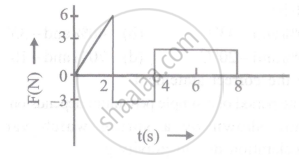
The force 'F' acting on a particle of mass 'm' is indicated by the force-time graph shown below. The change in momentum of the particle over the time interval from zero to 8s is:
A given coin has a mass of 3.0 g. Calculate the nuclear energy that would be required to separate all the neutrons and protons from each other. Assume that the coin is entirely made of \[_{29}^{63}Cu\] atoms (of mass 62.92960 u).
Before the advent of the theory of special relativity, what was the presumption regarding mass and energy in a reaction?
Which of the following is the famous mass-energy equivalence relation given by Einstein?
In the relation \[E = mc^2\], the quantity E represents:
In Einstein's mass-energy equivalence relation, the symbol c stands for:
The approximate value of the velocity of light in vacuum used in the mass-energy equivalence relation is:
