Calculate the Mass of an α-particle. Its Its Binding Energy is 28.2 Mev.
Advertisements
प्रश्न
Calculate the mass of an α-particle. Its Its binding energy is 28.2 MeV.
(Use Mass of proton mp = 1.007276 u, Mass of `""_1^1"H"` atom = 1.007825 u, Mass of neutron mn = 1.008665 u, Mass of electron = 0.0005486 u ≈ 511 keV/c2,1 u = 931 MeV/c2.)
Advertisements
उत्तर
Given:-
Binding energy of α particle = 28.2 MeV
Let x be the mass of α particle.
We know an α particle consists of 2 protons and 2 neutrons.
Binding energy ,
`B = (Zm_p + Nm_n - M)c^2`
Here, mp = Mass of proton
mn = Mass of neutron
Z= Number of protons
N = Number of neutrons
c = Speed of light
On substituting the respective values, we have
`28.2 = (2 xx 1.007276 + 2 xx 1.008665 - x)c^2`
`⇒ x = 4.0016 "u"`
APPEARS IN
संबंधित प्रश्न
In a typical nuclear reaction, e.g.
`"_1^2H+"_1^2H ->"_2^3He + n + 3.27 \text { MeV },`
although number of nucleons is conserved, yet energy is released. How? Explain.
A heavy nucleus X of mass number 240 and binding energy per nucleon 7.6 MeV is split into two fragments Y and Z of mass numbers 110 and 130. The binding energy of nucleons in Y and Z is 8.5 MeV per nucleon. Calculate the energy Q released per fission in MeV.
Suppose we have 12 protons and 12 neutrons. We can assemble them to form either a 24Mg nucleus or two 12C nuclei. In which of the two cases more energy will be liberated?
The mass number of a nucleus is equal to
Which of the following is a wrong description of binding energy of a nucleus?
For nuclei with A > 100,
(a) the binding energy of the nucleus decreases on an average as A increases
(b) the binding energy per nucleon decreases on an average as A increases
(c) if the nucleus breaks into two roughly equal parts, energy is released
(d) if two nuclei fuse to form a bigger nucleus, energy is released.
A neutron star has a density equal to that of the nuclear matter. Assuming the star to be spherical, find the radius of a neutron star whose mass is 4.0 × 1030 kg (twice the mass of the sun).
The force 'F' acting on a particle of mass 'm' is indicated by the force-time graph shown below. The change in momentum of the particle over the time interval from zero to 8s is:
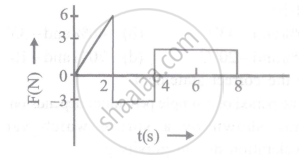
A given coin has a mass of 3.0 g. Calculate the nuclear energy that would be required to separate all the neutrons and protons from each other. Assume that the coin is entirely made of \[_{29}^{63}Cu\] atoms (of mass 62.92960 u).
Which of the following is the famous mass-energy equivalence relation given by Einstein?
In the relation \[E = mc^2\], the quantity E represents:
In Einstein's mass-energy equivalence relation, the symbol c stands for:
The approximate value of the velocity of light in vacuum used in the mass-energy equivalence relation is:
Experimental verification of Einstein's mass-energy relation has been achieved in the study of:
In a reaction, the conservation law of energy states that the initial energy and the final energy are equal, provided that:
Calculate the energy equivalent of 1 g of substance.
