Advertisements
Advertisements
प्रश्न
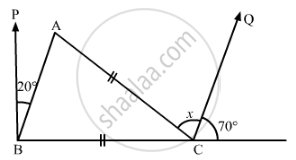
In the given figure, if BP || CQ and AC = BC, then the measure of x is
पर्याय
20°
25°
30°
35°
Advertisements
उत्तर
In the given figure, BP || CQ and AC || BC
We need to find the measure of x
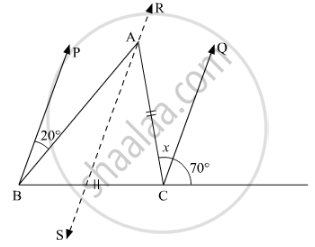
Here, we draw a line RS parallel to BP, i.e BP || RS
Also, using the property, “two lines parallel to the same line are parallel to each other”
As,
BP || RS
BP || CQ
Thus, RS || CQ
Now, BP || RS and BA is the transversal, so using the property, “alternate interior angles are equal”
∠PBA = ∠BAS
∠BAS = 20° .......... (1)
Similarly, CQ|| RS and AC is the transversal
∠QCA = ∠SAC
∠SAC = x ........(2)
Adding (1) and (2), we get
∠SAC + ∠BAS = 20° + x
∠A = 20° + x
Also, as AC = BC
Using the property,”angles opposite to equal sides are equal”, we get
∠ABC = ∠CAB
∠ABC = 20° + x
Further, using the property, “an exterior angle is equal to the sum of the two opposite interior angles”
In ΔABC
ext. ∠C = ∠CAB + ∠ABC
70° + x = 20° + x + 20° + x
70° + x = 40° + 2x
70° - 40° = 2x - x
x = 30°
Thus, x = 30°
APPEARS IN
संबंधित प्रश्न
In ΔABC, AD is the perpendicular bisector of BC (see the given figure). Show that ΔABC is an isosceles triangle in which AB = AC.

ΔABC is an isosceles triangle in which AB = AC. Side BA is produced to D such that AD = AB (see the given figure). Show that ∠BCD is a right angle.

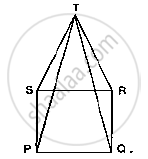
In Fig. 10.23, PQRS is a square and SRT is an equilateral triangle. Prove that
(i) PT = QT (ii) ∠TQR = 15°
If the bisector of the exterior vertical angle of a triangle be parallel to the base. Show that the triangle is isosceles.
ABC is a right angled triangle in which ∠A = 90° and AB = AC. Find ∠B and ∠C.
In a ΔPQR, if PQ = QR and L, M and N are the mid-points of the sides PQ, QR and RP
respectively. Prove that LN = MN.
Which of the following statements are true (T) and which are false (F):
If the bisector of the vertical angle of a triangle bisects the base, then the triangle may be isosceles.
Fill the blank in the following so that the following statement is true.
Sides opposite to equal angles of a triangle are ......
In ΔABC, side AB is produced to D so that BD = BC. If ∠B = 60° and ∠A = 70°, prove that: (i) AD > CD (ii) AD > AC
Prove that the perimeter of a triangle is greater than the sum of its altitudes.
Which of the following statements are true (T) and which are false (F)?
Difference of any two sides of a triangle is equal to the third side.
ABC is a triangle. The bisector of the exterior angle at B and the bisector of ∠C intersect each other at D. Prove that ∠D = \[\frac{1}{2}\] ∠A.
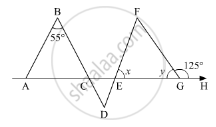
In the given figure, if AB || DE and BD || FG such that ∠FGH = 125° and ∠B = 55°, find x and y.
In a triangle ABC, if AB = AC and AB is produced to D such that BD = BC, find ∠ACD: ∠ADC.
In a ΔABC, if ∠A = 60°, ∠B = 80° and the bisectors of ∠B and ∠C meet at O, then ∠BOC =
M is a point on side BC of a triangle ABC such that AM is the bisector of ∠BAC. Is it true to say that perimeter of the triangle is greater than 2 AM? Give reason for your answer.
