Advertisements
Advertisements
प्रश्न
In answering a question on a multiple choice test, a student either knows the answer or guesses. Let 3/4 be the probability that he knows the answer and 1/4 be the probability that he guesses. Assuming that a student who guesses at the answer will be correct with probability 1/4 What is the probability that the student knows the answer given that he answered it correctly?
Advertisements
उत्तर
Let E1: know the answer; E2: be the placement of students.
E: The student gives the correct answer.
Then P(E1) = `3/4`, P(E2) = `1/4` or P(E|E1) = 1, P(E|E2) = `1/4`
Hence, from Baye's theorem
P(E1|E) = `(P(E_1) xx P(E|E_1))/(P(E_1) xx P(E|E_1) + P(E_2) xx P(E|E_2)`
= `(3/4 xx 1)/(3/4 xx 1+ 1/4 xx 1/4)`
= `(3/4)/(3/4 + 1/4)`
= `(3/4)/(13/16)`
= `3/4 xx 16/13`
= `12/13`
APPEARS IN
संबंधित प्रश्न
There are three coins. One is a two-headed coin (having head on both faces), another is a biased coin that comes up heads 75% of the times and the third is also a biased coin that comes up tails 40% of the time. One of the three coins is chosen at random and tossed and it shows heads. What is the probability that it was the two-headed coin?
There are three coins. One is two headed coin (having head on both faces), another is a biased coin that comes up heads 75% of the time and third is an unbiased coin. One of the three coins is chosen at random and tossed, it shows heads, what is the probability that it was the two headed coin?
An insurance company insured 2000 scooter drivers, 4000 car drivers and 6000 truck drivers. The probability of accidents are 0.01, 0.03 and 0.15 respectively. One of the insured persons meets with an accident. What is the probability that he is a scooter driver?
Suppose a girl throws a die. If she gets a 5 or 6, she tosses a coin three times and notes the number of heads. If she gets 1, 2, 3 or 4, she tosses a coin once and notes whether a head or tail is obtained. If she obtained exactly one head, what is the probability that she threw 1, 2, 3 or 4 with the die?
A manufacturer has three machine operators A, B and C. The first operator A produces 1% defective items, where as the other two operators B and C produce 5% and 7% defective items respectively. A is on the job for 50% of the time, B is on the job for 30% of the time and C is on the job for 20% of the time. A defective item is produced, what is the probability that was produced by A?
Probability that A speaks truth is `4/5` . A coin is tossed. A reports that a head appears. The probability that actually there was head is ______.
Suppose a girl throws a die. If she gets 1 or 2 she tosses a coin three times and notes the number of tails. If she gets 3,4,5 or 6, she tosses a coin once and notes whether a ‘head’ or ‘tail’ is obtained. If she obtained exactly one ‘tail’, what is the probability that she threw 3,4,5 or 6 with the die ?
Three urns contains 2 white and 3 black balls; 3 white and 2 black balls and 4 white and 1 black ball respectively. One ball is drawn from an urn chosen at random and it was found to be white. Find the probability that it was drawn from the first urn.
Suppose 5 men out of 100 and 25 women out of 1000 are good orators. An orator is chosen at random. Find the probability that a male person is selected. Assume that there are equal number of men and women.
A company has two plants to manufacture bicycles. The first plant manufactures 60% of the bicycles and the second plant 40%. Out of the 80% of the bicycles are rated of standard quality at the first plant and 90% of standard quality at the second plant. A bicycle is picked up at random and found to be standard quality. Find the probability that it comes from the second plant.
Of the students in a college, it is known that 60% reside in a hostel and 40% do not reside in hostel. Previous year results report that 30% of students residing in hostel attain A grade and 20% of ones not residing in hostel attain A grade in their annual examination. At the end of the year, one students is chosen at random from the college and he has an A grade. What is the probability that the selected student is a hosteler?
Coloured balls are distributed in four boxes as shown in the following table:
| Box | Colour | |||
| Black | White | Red | Blue | |
| I II III IV |
3 2 1 4 |
4 2 2 3 |
5 2 3 1 |
6 2 1 5 |
A box is selected at random and then a ball is randomly drawn from the selected box. The colour of the ball is black, what is the probability that ball drawn is from the box III.
If a machine is correctly set up it produces 90% acceptable items. If it is incorrectly set up it produces only 40% acceptable item. Past experience shows that 80% of the setups are correctly done. If after a certain set up, the machine produces 2 acceptable items, find the probability that the machine is correctly set up.
A test for detection of a particular disease is not fool proof. The test will correctly detect the disease 90% of the time, but will incorrectly detect the disease 1% of the time. For a large population of which an estimated 0.2% have the disease, a person is selected at random, given the test, and told that he has the disease. What are the chances that the person actually have the disease?
Let d1, d2, d3 be three mutually exclusive diseases. Let S be the set of observable symptoms of these diseases. A doctor has the following information from a random sample of 5000 patients: 1800 had disease d1, 2100 has disease d2, and others had disease d3. 1500 patients with disease d1, 1200 patients with disease d2, and 900 patients with disease d3 showed the symptom. Which of the diseases is the patient most likely to have?
In answering a question on a multiple choice test a student either knows the answer or guesses. Let \[\frac{3}{4}\] be the probability that he knows the answer and \[\frac{1}{4}\] be the probability that he guesses. Assuming that a student who guesses at the answer will be correct with probability \[\frac{1}{4}\]. What is the probability that a student knows the answer given that he answered it correctly?
There are three categories of students in a class of 60 students:
A : Very hardworking ; B : Regular but not so hardworking; C : Careless and irregular 10 students are in category A, 30 in category B and the rest in category C. It is found that the probability of students of category A, unable to get good marks in the final year examination is 0.002, of category B it is 0.02 and of category C, this probability is 0.20. A student selected at random was found to be one who could not get good marks in the examination. Find the probability that this student is category C.
A box contains 2 blue and 3 pink balls and another box contains 4 blue and 5 pink balls. One ball is drawn at random from one of the two boxes and it is found to be pink. Find the probability that it was drawn from first box
A box contains 2 blue and 3 pink balls and another box contains 4 blue and 5 pink balls. One ball is drawn at random from one of the two boxes and it is found to be pink. Find the probability that it was drawn from second box
There is a working women's hostel in a town, where 75% are from neighbouring town. The rest all are from the same town. 48% of women who hail from the same town are graduates and 83% of the women who have come from the neighboring town are also graduates. Find the probability that a woman selected at random is a graduate from the same town
If E1 and E2 are equally likely, mutually exclusive and exhaustive events and `"P"("A"/"E"_1 )` = 0.2, `"P"("A"/"E"_2)` = 0.3. Find `"P"("E"_1/"A")`
Jar I contains 5 white and 7 black balls. Jar II contains 3 white and 12 black balls. A fair coin is flipped; if it is Head, a ball is drawn from Jar I, and if it is Tail, a ball is drawn from Jar II. Suppose that this experiment is done and a white ball was drawn. What is the probability that this ball was in fact taken from Jar II?
A box contains three coins: two fair coins and one fake two-headed coin is picked randomly from the box and tossed. If happens to be head, what is the probability that it is the two-headed coin?
(Activity):
Mr. X goes to office by Auto, Car, and train. The probabilities him travelling by these modes are `2/7, 3/7, 2/7` respectively. The chances of him being late to the office are `1/2, 1/4, 1/4` respectively by Auto, Car, and train. On one particular day, he was late to the office. Find the probability that he travelled by car.
Solution: Let A, C and T be the events that Mr. X goes to office by Auto, Car and Train respectively. Let L be event that he is late.
Given that P(A) = `square`, P(C) = `square`
P(T) = `square`
P(L/A) = `1/2`, P(L/C) = `square` P(L/T) = `1/4`
P(L) = P(A ∩ L) + P(C ∩ L) + P(T ∩ L)
`="P"("A")*"P"("L"//"A") + "P"("C")*"P"("L"//"C") + "P"("T")*"P"("L"//"T")`
`= square * square + square * square + square * square`
`= square + square + square`
`= square`
`"P"("C"//"L") = ("P"("L" ∩ "C"))/("P"("L"))`
= `("P"("C") * "P"("L"//"C"))/("P"("L"))`
`= (square * square)/square`
`= square`
Solve the following:
In a factory which manufactures bulbs, machines A, B and C manufacture respectively 25%, 35% and 40% of the bulbs. Of their outputs, 5, 4 and 2 percent are respectively defective bulbs. A bulbs is drawn at random from the product and is found to be defective. What is the probability that it is manufactured by the machine B?
A shopkeeper sells three types of flower seeds A1, A2 and A3. They are sold as a mixture where the proportions are 4:4:2 respectively. The germination rates of the three types of seeds are 45%, 60% and 35%. Calculate the probability that it is of the type A2 given that a randomly chosen seed does not germinate.
A letter is known to have come either from TATA NAGAR or from CALCUTTA. On the envelope, just two consecutive letter TA are visible. What is the probability that the letter came from TATA NAGAR.
Probability that 'A' speaks truth is `4/5`. A coin is taked. A reports that head appears. the probability that actually there was head is
There are two boxes, namely box-I and box-II. Box-I contains 3 red and 6 black balls. Box-II contains 5 red and 5 black balls. One of the two boxes, is selected at random and a ball is drawn at random. The ball drawn is found to be red. Find the probability that this red ball comes out from box-II.
Read the following passage and answer the questions given below.
|
A shopkeeper sells three types of flower seeds A1, A2, A3. They are sold is the form of a mixture, where the proportions of these seeds are 4:4:2 respectively. The germination rates of the three types of seeds are 45%, 60% and 35% respectively.
|
Based on the above information:
- Calculate the probability that a randomly chosen seed will germinate.
- Calculate the probability that the seed is of type A2, given that a randomly chosen seed germinates.
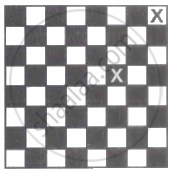
Let P denotes the probability of selecting one white and one black square from the chessboard so that they are not in the same row and also not in the same column (an example of this kind of the choice is shown in figure), then (1024)P is ______.
A speaks truth in 75% of the cases and B in 80% of the cases. The percentage of cases they are likely to contradict each other in making the same statement is ______.
A jewellery seller has precious gems in white and red colour which he has put in three boxes.
The distribution of these gems is shown in the table given below:
| Box | Number of Gems | |
| White | Red | |
| I | 1 | 2 |
| I | 2 | 3 |
| III | 3 | 1 |
He wants to gift two gems to his mother. So, he asks her to select one box at random and pick out any two gems one after the other without replacement from the selected box. The mother selects one white and one red gem.
Calculate the probability that the gems drawn are from Box II.
Why is Bayes' Theorem often called a method of finding reverse probability?
What does posterior probability mean?
In a typical Bayes' Theorem question, what is usually given in the question statement?
