Advertisements
Advertisements
प्रश्न
A box contains three coins: two fair coins and one fake two-headed coin is picked randomly from the box and tossed. If happens to be head, what is the probability that it is the two-headed coin?
Advertisements
उत्तर
Let event A: Fair coin is tossed,
event B: Fake coin is tossed and
event H: Head occur.
Clearly, a fair coin has one head.
∴ Probability that head occur under the condition that the fair coin is tossed = `"P"("H"/"A") = 1/2`.
Fake coin has two heads.
∴ Probability that head occur under the condition that the fake coin is tossed
= `"P"("H"/"B")` = 1
n(A) = 2, n(B) = 1, n(S) = 3
∴ P(A) = `("n"("A"))/("n"("S"))=2/3`, P(B) = `("n"("B"))/("n"("S"))=1/3`
Required probability = `"P"("B"/"H")`
By Baye’s theorem
`"P"("B"/"H") = ("P"("B") "P"("H"/"B"))/("P"("H"))`
= `(1/3 xx 1)/(2/3)`
= `1/2`
APPEARS IN
संबंधित प्रश्न
There are three coins. One is a two-headed coin (having head on both faces), another is a biased coin that comes up heads 75% of the times and the third is also a biased coin that comes up tails 40% of the time. One of the three coins is chosen at random and tossed and it shows heads. What is the probability that it was the two-headed coin?
An urn contains 5 red and 5 black balls. A ball is drawn at random, its colour is noted and is returned to the urn. Moreover, 2 additional balls of the colour drawn are put in the urn and then a ball is drawn at random. What is the probability that the second ball is red?
Probability that A speaks truth is `4/5` . A coin is tossed. A reports that a head appears. The probability that actually there was head is ______.
Three machines E1, E2 and E3 in a certain factory producing electric bulbs, produce 50%, 25% and 25% respectively, of the total daily output of electric bulbs. It is known that 4% of the bulbs produced by each of machines E1 and E2are defective and that 5% of those produced by machine E3 are defective. If one bulb is picked up at random from a day's production, calculate the probability that it is defective.
Three urns contains 2 white and 3 black balls; 3 white and 2 black balls and 4 white and 1 black ball respectively. One ball is drawn from an urn chosen at random and it was found to be white. Find the probability that it was drawn from the first urn.
In a class, 5% of the boys and 10% of the girls have an IQ of more than 150. In this class, 60% of the students are boys. If a student is selected at random and found to have an IQof more than 150, find the probability that the student is a boy.
An item is manufactured by three machines A, B and C. Out of the total number of items manufactured during a specified period, 50% are manufactured on machine A, 30% on Band 20% on C. 2% of the items produced on A and 2% of items produced on B are defective and 3% of these produced on C are defective. All the items stored at one godown. One item is drawn at random and is found to be defective. What is the probability that it was manufactured on machine A?
There are three coins. One is two-headed coin (having head on both faces), another is biased coin that comes up heads 75% of the times and third is also a biased coin that comes up tail 40% of the times. One of the three coins is chosen at random and tossed, and it shows heads. What is the probability that it was the two-headed coin?
A factory has three machines A, B and C, which produce 100, 200 and 300 items of a particular type daily. The machines produce 2%, 3% and 5% defective items respectively. One day when the production was over, an item was picked up randomly and it was found to be defective. Find the probability that it was produced by machine A.
In a certain college, 4% of boys and 1% of girls are taller than 1.75 metres. Further more, 60% of the students in the colleges are girls. A student selected at random from the college is found to be taller than 1.75 metres. Find the probability that the selected students is girl.
Three persons A, B and C apply for a job of Manager in a Private Company. Chances of their selection (A, B and C) are in the ratio 1 : 2 :4. The probabilities that A, B and C can introduce changes to improve profits of the company are 0.8, 0.5 and 0.3, respectively. If the change does not take place, find the probability that it is due to the appointment of C.
There are three coins. One is two headed coin, another is a biased coin that comes up heads 75% of the time and third is an unbiased coin. One of the three coins is chosen at random and tossed, it shows heads, what is the probability that it was the two headed coin?
A speaks the truth 8 times out of 10 times. A die is tossed. He reports that it was 5. What is the probability that it was actually 5?
In answering a question on a multiple choice test a student either knows the answer or guesses. Let \[\frac{3}{4}\] be the probability that he knows the answer and \[\frac{1}{4}\] be the probability that he guesses. Assuming that a student who guesses at the answer will be correct with probability \[\frac{1}{4}\]. What is the probability that a student knows the answer given that he answered it correctly?
There are three categories of students in a class of 60 students:
A : Very hardworking ; B : Regular but not so hardworking; C : Careless and irregular 10 students are in category A, 30 in category B and the rest in category C. It is found that the probability of students of category A, unable to get good marks in the final year examination is 0.002, of category B it is 0.02 and of category C, this probability is 0.20. A student selected at random was found to be one who could not get good marks in the examination. Find the probability that this student is category C.
There are three bags, each containing 100 marbles. Bag 1 has 75 red and 25 blue marbles. Bag 2 has 60 red and 40 blue marbles and Bag 3 has 45 red and 55 blue marbles. One of the bags is chosen at random and a marble is picked from the chosen bag. What is the probability that the chosen marble is red?
A box contains 2 blue and 3 pink balls and another box contains 4 blue and 5 pink balls. One ball is drawn at random from one of the two boxes and it is found to be pink. Find the probability that it was drawn from first box
A diagnostic test has a probability 0.95 of giving a positive result when applied to a person suffering from a certain disease, and a probability 0.10 of giving a (false) positive result when applied to a non-sufferer. It is estimated that 0.5% of the population are sufferers. Suppose that the test is now administered to a person about whom we have no relevant information relating to the disease (apart from the fact that he/she comes from this population). Calculate the probability that: given a positive result, the person is a sufferer
A diagnostic test has a probability 0.95 of giving a positive result when applied to a person suffering from a certain disease, and a probability 0.10 of giving a (false) positive result when applied to a non-sufferer. It is estimated that 0.5% of the population are sufferers. Suppose that the test is now administered to a person about whom we have no relevant information relating to the disease (apart from the fact that he/she comes from this population). Calculate the probability that: given a negative result, the person is a non-sufferer
A doctor is called to see a sick child. The doctor has prior information that 80% of the sick children in that area have the flu, while the other 20% are sick with measles. Assume that there is no other disease in that area. A well-known symptom of measles is rash. From the past records, it is known that, chances of having rashes given that sick child is suffering from measles is 0.95. However occasionally children with flu also develop rash, whose chance are 0.08. Upon examining the child, the doctor finds a rash. What is the probability that child is suffering from measles?
(Activity):
Mr. X goes to office by Auto, Car, and train. The probabilities him travelling by these modes are `2/7, 3/7, 2/7` respectively. The chances of him being late to the office are `1/2, 1/4, 1/4` respectively by Auto, Car, and train. On one particular day, he was late to the office. Find the probability that he travelled by car.
Solution: Let A, C and T be the events that Mr. X goes to office by Auto, Car and Train respectively. Let L be event that he is late.
Given that P(A) = `square`, P(C) = `square`
P(T) = `square`
P(L/A) = `1/2`, P(L/C) = `square` P(L/T) = `1/4`
P(L) = P(A ∩ L) + P(C ∩ L) + P(T ∩ L)
`="P"("A")*"P"("L"//"A") + "P"("C")*"P"("L"//"C") + "P"("T")*"P"("L"//"T")`
`= square * square + square * square + square * square`
`= square + square + square`
`= square`
`"P"("C"//"L") = ("P"("L" ∩ "C"))/("P"("L"))`
= `("P"("C") * "P"("L"//"C"))/("P"("L"))`
`= (square * square)/square`
`= square`
Solve the following:
The ratio of Boys to Girls in a college is 3:2 and 3 girls out of 500 and 2 boys out of 50 of that college are good singers. A good singer is chosen what is the probability that the chosen singer is a girl?
Suppose you have two coins which appear identical in your pocket. You know that one is fair and one is 2-headed. If you take one out, toss it and get a head, what is the probability that it was a fair coin?
An item is manufactured by three machines A, B and C. Out of the total number of items manufactured during a specified period, 50% are manufactured on A, 30% on B and 20% on C. 2% of the items produced on A and 2% of items produced on B are defective, and 3% of these produced on C are defective. All the items are stored at one godown. One item is drawn at random and is found to be defective. What is the probability that it was manufactured on machine A?
In a bolt factory, machines X, Y and Z manufacture 20%, 35% and 45% respectively of the total output. Of their output 8%, 6% and 5% respectively are defective bolts. One bolt is drawn at random from the product and is found to be defective. What is the probability that it was manufactured in machine Y?
Probability that 'A' speaks truth is `4/5`. A coin is taked. A reports that head appears. the probability that actually there was head is
There are two boxes, namely box-I and box-II. Box-I contains 3 red and 6 black balls. Box-II contains 5 red and 5 black balls. One of the two boxes, is selected at random and a ball is drawn at random. The ball drawn is found to be red. Find the probability that this red ball comes out from box-II.
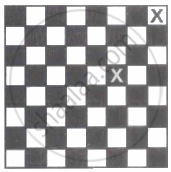
Let P denotes the probability of selecting one white and one black square from the chessboard so that they are not in the same row and also not in the same column (an example of this kind of the choice is shown in figure), then (1024)P is ______.
The probability that A speaks truth is `4/5`, while the probability for B is `3/4`. The probability that they contradict each other when asked to speak on a fact is ______.
In an entrance test, there are multiple choice questions. There are four possible answers to each question, of which one is correct. The probability that a student knows the answer to a question is 90%. If he gets the correct answer to a question, then the probability that he was guessing is ______.
In a company, 15% of the employees are graduates and 85% of the employees are non-graduates. As per the annual report of the company, 80% of the graduate employees and 10% of the non-graduate employees are in the Administrative positions. Find the probability that an employee selected at random from those working in administrative positions will be a graduate.
Why is Bayes' Theorem often called a method of finding reverse probability?
Bayes' Theorem works from _____ to _____.
What does prior probability mean?
What does posterior probability mean?
