Advertisements
Advertisements
प्रश्न
If you could buy your dream house today what are some specific features you
would want for your house? Write them in the bubbles below.

Advertisements
उत्तर

APPEARS IN
संबंधित प्रश्न
Answer the following question briefly
Which of the following traits are relevant to the character of the narrator's grandmother?
(i) determined
(ii) selfish
(iii) emotional
(iv)mean
Give reasons for your choice.
Answer the following question:
Describe Mr. Bramble as he has been described in the story.
Based on your reading of the story, answer the following questions by choosing
the correct option.
Pescud felt that best-sellers were not realistic as.
Answer the following questions:
How many hills and bridges does the brook pass during its journey?
Identify the rhyme scheme of the poem.
Imagine that you have just returned from Topo Island. The Editor of a local newspaper has asked you to write about your adventure. Write the article.
Some hints :
1) Very briefly, describe how you landed on the island, and the main features of the island.
2) Write about where you set up camp, describe one main adventure, and how you were eventually rescued.
3) Make the adventure part of your story exciting, with lots of action.
4) Include dialogue in the adventure part.
5) Try to create mystery and suspense, as in B.3.
6) Finally, give your adventure story a suitable heading.
7) Your story must be written in paragraphs and should carry your By line.
Choose three ‘since’ expressions and three ‘for’ expressions from the table above. Then write six sentences using the pattern in the box below.
I haven’t seen him since the day before yesterday.
I have not seen him for ages.
Here are a few questions and statements written down by the Cultural Secretary that she/ he needs to share. Tick the correct words from those given in brackets:
- How (much/many) (chair/chairs) do we need?
- (Much/Several) (school/schools) will be participating.
- (Several/Much) (student/students) have arrived.
- How (much/many) (information/informations) does this brochure give?
- We have only (a few/a little) sponsors for (some/much) events.
Carbon Footprint - Project Work
A carbon footprint is a representation of the effect human activities have on the climate in terms of the total amount of greenhouse gases produced (measured in units of carbon dioxide). So, it is a measure of the impact we make individually on the earth; by the choices we make regarding our lifestyle. Many activities generate carbon emissions, which contribute towards accelerating global warming and climate change.
Total carbon footprint/ emission quantification would include energy emissions from human activities - such as, from heat, light, power and refrigeration and all transport related emissions from cars, freight and distribution.
By measuring the carbon footprint through such tools as carbon calculators, we can get a better sense of what the individual impact is and which parts of our lifestyle deserve strict regulation.
In groups, choose and research any one aspect of how we are leaving carbon footprints and how can we modify our lifestyle. Each group will then make a project on the various aspects.
Now read this extract from a story and draw arrows (as in the example above) to show how the personal pronouns refer to the different people and things.
Leena was on her annual visit to her uncle's house. She always enjoyed it because she was allowed to spend most of the day down at the mango grove. Leena's uncle was a friend of the man who owned the grove and he always gave a special rate. This year Leena's aunt joined her, and together they set off across the fields to the grove. The branches of the trees were covered with fruits, and so bowed down with the weight that they almost touched the ground. They spent hours picking fruit, eating most of it and sleeping in the shade.
Read through the poem and quickly make a note of any thoughts that come to you, while you are reading it.
Dispute
A man and a tiger once had a dispute,
Which was reckoned greater, the man or the brute.
The tiger discoursed on his side at some length,
And greatly enlarged on his courage and strength,
Said the man, 'Don't be prating; look yonder, I pray,
At that sculpture of marble: now what will you say?
The tiger is vanquished; but as for the man,
He is striding upon him: deny if you can.'
'But pray,' said the tiger, 'Who sculptured that stone?
'One of us,' said the man. 'I must candidly own.'
'But when we are sculptors,' the other replied,
'You will then on the man see the tiger astride.'
Anonymous
Match the sentences in A with their meanings in B.
| A | B |
|
You should have taken your keys. You could/might have lost your keys at the cinema. You must have left your keys at home. |
It is possible that you left your keys. You are to blame for leaving your keys. I think that you probably left your keys. |
Look at the text below. The sentences have been jumbled up. Write them in order out to produce a complete paragraph. The first sentence has been given to help you.
(a) To conclude, like many things in life it is up to the individual to use TV wisely, or to abuse it and become its slave.
(b) By contrast, those who attack TV state that it makes people lazy by doing everything for them.
(c) Television is here to stay.
(d) In other words, it stifles rather than stimulates the imagination.
(e) Defenders of TV say that it is a wonderful source of information about things we can never hope to see or do in person.
(f) Moreover, they say it makes topics interesting which would otherwise be boring and difficult in books. .
(g) However, is it a boon or a curse?
(h) In fact, it has become an indispensable part of our lives.
(a) Television is here to stay. ____________________________________________________________________________________________________________________________________________________________________________________________________________________________________________________________________________________________________________________________________________________________________________________________________________________________________
(b) What helped you to put the sentence back in the correct order?
Prevention is better than cure.
Swine flu has been declared (as) a pandemic.
In groups of four discuss the following.
(a) What has been done by the authorities to cope with the problem?
(b) What are the consequences of such a major world-wide infection?
Write out the answer to the questions as a flowchart using the passive form of the verb.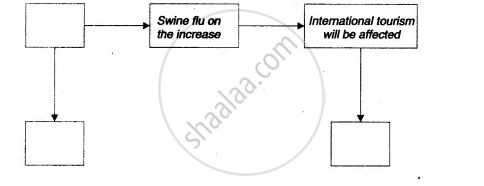
Write a magazine article about both the boys, in which you bring out the similarities and differences in their lives. Use the table you completed in Question 3. Give your article a suitable title. Remember 'CODER'.
Organise your article like this
Paragraph 1 : Give their names and ages. Compare their families, parents and backgrounds.
Paragraph 2 : Compare how each spends a typical day and their recreation/ hobbies.
Paragraph 3 : Compare their hopes / dreams / ambitions and your assessment of their future.
Given below is a list or other expressions. Decide what each expression means, by writing D for 'difference' or S for 'similarity' against each. Try to add more expressions to your list and make use of them in writing your article in Question 6.
| Expressions | D or s |
| X is different from Y in that _______ | |
| X and Y are alike in that ______ | |
| X and Y have _____ in common. | |
| Whereas X _________ , Y _____________ | |
| Compared to X, Y ________ | |
| X ____ In contrast, Y ____ | |
| X _____ However, Y _____ | |
| X and Y both |
Identify the functions of the prepositions in each of these sentences.
1. George Washington served as the Commander-in-Chief during the
American Revolutionary War.
2. The assassin shot the leader with a gun.
3. Pratap bequeathed his property to charity.
4. Manoj was awarded a certificate for his good conduct.
5. The roof is covered with fire-proof sheets.
Study the map and the key given below carefully, and complete the sentences that follow.

Key
- Lalnagar
- Sarkor
- Timpur
- Rampur (Capital)
- Marwah
- Chickoor
- Strange Lake
- Neverest Hills
- Nafran
- Lakshrnanpur
(a)
|
__________________________ Rampur
|
is is situated lies ____________ is located |
half-way along the west coast of Halsi Island.
on the south coast of the island, north of ___ |
(b) Now describe the position of the other eight places, using some of the words in
the box.
| at | along | among |
| to | next to | opposite |
| on | between | |
| in | above | |
| by | below | |
| over | ||
| under |
Look at the map below.
You have invited three friends to a party at your house. Write three separate notes, giving them directions from 1, 2 and 3 to your house. You may use the words in the box.

The directions from (1) are given here as an example
Go down Diwan Marg and turn right down Antonio Avenue. Walk as far as the traffic lights then turn right into Mount Road. Turn first left into The Crescent and my house is on the left.
________________________________
Study the following sentences. Select the one underlined word which is incorrect. Write the incorrect word in the boxes provided. One has been done as an example.
e.g. Advertisements can be extremely useful if they were honest and help you decide what to buy.
| were |
(a) For example, if you break your pen, but want to buy another, the first thing to do is look at advertisements.
(b) This will help you choose the good type of pen.
(c) However, advertisements can be harmful when it try to exploit the public.
(d) It had found that young people, especially teenagers, are affected the most by advertisements.
