Advertisements
Advertisements
प्रश्न
If a sphere is inscribed in a cube, find the ratio of the volume of cube to the volume of the sphere.
Advertisements
उत्तर
In the given problem, we are given a sphere inscribed in a cube. So, here we need to find the ratio between the volume of a cube and volume of sphere. This means that the diameter of the sphere will be equal to the side of the cube. Let us take the diameter as d.
Here,
Volume of a cube (V1) = s3
= d3
Volume of a sphere (V2) `=(4/3)pi (d/2)^3`
`=(4/3) pi (d^3/8)`
`=(pid^3)/6`
Now, the ratio of the volume of sphere to the volume of the cube = `V_1/V_2`
`V_1/V_2 = d^3/(((pi d^3)/6))`
`= 6/pi`
So, the ratio of the volume of cube to the volume of the sphere is `6 : pi` .
APPEARS IN
संबंधित प्रश्न
The radius of a spherical balloon increases from 7 cm to 14 cm as air is being pumped into it. Find the ratio of surface areas of the balloon in the two cases.
A hemispherical bowl is made of steel, 0.25 cm thick. The inner radius of the bowl is 5 cm. Find the outer curved surface area of the bowl.
`["Assume "pi = 22/7]`
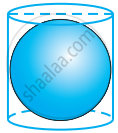
A right circular cylinder just encloses a sphere of radius r (see figure). Find
- surface area of the sphere,
- curved surface area of the cylinder,
- ratio of the areas obtained in (i) and (ii).
Find the total surface area of a hemisphere and a solid hemisphere each of radius 10 cm.
(Use 𝜋 = 3.14)
A hemispherical bowl made of brass has inner diameter 10.5 cm. Find the cost of tin- plating
it on the inside at the rate of Rs. 4 per 100 `cm^2`
A hemi-spherical dome of a building needs to be painted. If the circumference of the base of
the dome is 17.6 cm, find the cost of painting it, given the cost of painting is Rs. 5 per l00
`cm^2`
A solid rectangular block of metal 49 cm by 44 cm by 18 cm is melted and formed into a solid sphere. Calculate the radius of the sphere.
A largest sphere is to be carved out of a right circular cylinder of radius 7 cm and height 14 cm. Find the volume of the sphere.
If a sphere of radius 2r has the same volume as that of a cone with circular base of radius r, then find the height of the cone.
Mark the correct alternative in each of the following:
In a sphere the number of faces is
If a sphere is inscribed in a cube, then the ratio of the volume of the sphere to the volume of the cube is
If a solid sphere of radius r is melted and cast into the shape of a solid cone of height r, then the radius of the base of the cone is
A cone and a hemisphere have equal bases and equal volumes the ratio of their heights is
The model of a building is constructed with the scale factor 1 : 30.
(i) If the height of the model is 80 cm, find the actual height of the building in meters.
(ii) If the actual volume of a tank at the top of the building is 27m3, find the volume of the tank on the top of the model.
Find the surface area and volume of sphere of the following radius. (π = 3.14)
4 cm
Find the volume of the hollow sphere whose inner diameter is 8 cm and the thickness of the material of which it is made is 1 cm .
The surface area of a solid metallic sphere is 2464 cm2. It is melted and recast into solid right circular cones of radius 3.5 cm and height 7 cm. Calculate : the number of cones recast. `("Take" pi =22/7)`
From a rectangular solid of metal 42 cm by 30 cm by 20 cm, a conical cavity of diameter 14 cm and depth 24 cm is drilled out. Find: the volume of remaining solid
