Advertisements
Advertisements
प्रश्न
A spherical ball of lead has been melted and made into identical smaller balls with radius equal to half the radius of the original one. How many such balls can be made?
Advertisements
उत्तर
Let the radius of spherical ball = r
∴ Volume = `4/3pir^3`
Radius of smaller ball = `r/2`
∴ Volume of smaller ball = `4/3pi(r/2)^3`
= `4/3pir^3/8`
= `(pir^3)/6`
Therefore, number of smaller balls made out of the given ball
= `(4/3pir^3)/((pir^3)/6)`
= `4/3 xx 6`
= 8
APPEARS IN
संबंधित प्रश्न
The diameter of the moon is approximately one-fourth of the diameter of the earth. Find the ratio of their surface area.
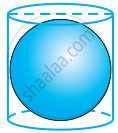
A right circular cylinder just encloses a sphere of radius r (see figure). Find
- surface area of the sphere,
- curved surface area of the cylinder,
- ratio of the areas obtained in (i) and (ii).
Eight metallic spheres; each of radius 2 mm, are melted and cast into a single sphere. Calculate the radius of the new sphere.
How many spherical bullets can be made out of a solid cube of lead whose edge measures 44 cm, each bullet being 4 cm in diameter?
Mark the correct alternative in each of the following:
In a sphere the number of faces is
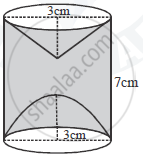
A hemispherical and a conical hole is scooped out of a.solid wooden cylinder. Find the volume of the remaining solid where the measurements are as follows:
The height of the solid cylinder is 7 cm, radius of each of hemisphere, cone and cylinder is 3 cm. Height of cone is 3 cm.
Give your answer correct to the nearest whole number.Taken`pi = 22/7`.
Find the volume of a sphere, if its surface area is 154 sq.cm.
A hemispherical bowl of internal radius 9 cm is full of liquid. This liquid is to be filled into conical shaped small containers each of diameter 3 cm and height 4 cm. How many containers are necessary to empty the bowl?
A solid, consisting of a right circular cone standing on a hemisphere, is placed upright, in a right circular cylinder, full of water and touches the bottom. Find the volume of water left in the cylinder, having given that the radius of the cylinder is 3 cm and its height is 6 cm; the radius of the hemisphere is 2 cm and the height of the cone is 4 cm. Give your answer to the nearest cubic centimetre.
A spherical ball of radius 3 cm is melted and recast into three spherical balls. The radii of two of the balls are 1.5 cm and 2 cm. Find the diameter of the third ball.
