Advertisements
Advertisements
प्रश्न
The volume of one sphere is 27 times that of another sphere. Calculate the ratio of their :
- radii,
- surface areas.
Advertisements
उत्तर
Volume of first sphere = 27 × volume of second sphere
Let radius of first sphere = r1
And radius of second sphere = r2
Therefore, volume of first sphere = `4/3pir_1^3`
And volume of second sphere = `4/3pir_2^3`
i. Now, according to the question
= `4/3pir_1^3`
= `27 xx 4/3pir_2^3`
`r_1^3 = 27r_2^3 = (3r_2)^3`
`=>` r1 = 3r2
`=> r_1/r_2 = 3/1`
∴ r1 : r2 = 3 : 1
ii. Surface area of first sphere = `4pir_1^2`
And surface area of second sphere = `4pir_2^2`
Ratio in surface area = `(4pir_1^2)/(4pir_2^2)`
= `r_1^2/r_2^2`
= `3^2/1^2`
= `9/1`
= 9 : 1
APPEARS IN
संबंधित प्रश्न
The radius of a spherical balloon increases from 7 cm to 14 cm as air is being pumped into it. Find the ratio of surface areas of the balloon in the two cases.
The diameter of the moon is approximately one-fourth of the diameter of the earth. Find the ratio of their surface area.
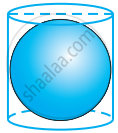
A right circular cylinder just encloses a sphere of radius r (see figure). Find
- surface area of the sphere,
- curved surface area of the cylinder,
- ratio of the areas obtained in (i) and (ii).
A hollow sphere of internal and external radii 6 cm and 8 cm respectively is melted and recast into small cones of base radius 2 cm and height 8 cm. Find the number of cones.
The dome of a building is in the form of a hemisphere. Its radius is 63 dm. Find the cost of painting it at the rate of Rs. 2 per sq. m.
A cylinder of same height and radius is placed on the top of a hemisphere. Find the curved
surface area of the shape if the length of the shape be 7 cm.
A sphere is placed inside a right circular cylinder so as to touch the top, base and lateral surface of the cylinder. If the radius of the sphere is r, then the volume of the cylinder is
A cone, a hemisphere and a cylinder stand on equal bases and have the same height. The ratio of their volumes is
The surface area of a solid metallic sphere is 2464 cm2. It is melted and recast into solid right circular cones of radius 3.5 cm and height 7 cm. Calculate : the number of cones recast. `("Take" pi =22/7)`
The radius of two spheres are in the ratio of 1 : 3. Find the ratio between their volume.
