Advertisements
Advertisements
प्रश्न
A solid is in the form of a cone standing on a hemi-sphere with both their radii being equal to 8 cm and the height of cone is equal to its radius. Find, in terms of π, the volume of the solid.
Advertisements
उत्तर
Given, Radius of each cone and hemi-sphere (r) = 8 cm
Height of cone (h) = r = 8 cm

∴ Volume of solid
= `1/3pir^2h + 2/3pir^3`
= `1/3pir^2(h + 2r) cm^3`
= `1/3pi xx 8 xx 8(8 + 2 xx 8) cm^3`
= `64/3 pi(8 + 16) cm^3`
= `64/3pi xx 24`
= 512 π cm3
APPEARS IN
संबंधित प्रश्न
Find the total surface area of a hemisphere of radius 10 cm. [Use π = 3.14]
Find the surface area of a sphere of radius 10.5 cm.
Find the surface area of a sphere of diameter 21 cm.
A largest sphere is to be carved out of a right circular cylinder of radius 7 cm and height 14 cm. Find the volume of the sphere.
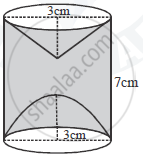
A hemispherical and a conical hole is scooped out of a.solid wooden cylinder. Find the volume of the remaining solid where the measurements are as follows:
The height of the solid cylinder is 7 cm, radius of each of hemisphere, cone and cylinder is 3 cm. Height of cone is 3 cm.
Give your answer correct to the nearest whole number.Taken`pi = 22/7`.
How many lead balls of radii 1 cm each can be made from a sphere of 8 cm radius?
A hemispherical bowl of internal radius 9 cm is full of liquid. This liquid is to be filled into conical shaped small containers each of diameter 3 cm and height 4 cm. How many containers are necessary to empty the bowl?
The surface area of a solid metallic sphere is 2464 cm2. It is melted and recast into solid right circular cones of radius 3.5 cm and height 7 cm. Calculate : the number of cones recast. `("Take" pi =22/7)`
A vessel is in he form of an inverted cone. Its height is 11 cm., and the radius of its top which is open is 2.5 cm. It is filled with water up to the rim. When lead shots, each of which is a sphere of radius 0.25 cm., are dropped 2 into the vessel, `2/5`th of the water flows out. Find the number of lead shots dropped into the vessel.
The total surface area of a hemisphere is how many times the square of its radius
