Advertisements
Advertisements
प्रश्न
Eight metallic spheres; each of radius 2 mm, are melted and cast into a single sphere. Calculate the radius of the new sphere.
Advertisements
उत्तर
Radius of metallic sphere = `2 mm = 1/5 cm`
Volume = `4/3pir^3`
= `4/3 xx 22/7 xx 1/5 xx 1/5 xx 1/5`
= `88/(21 xx 125) cm^3`
Volume of 8 spheres = `(88 xx 8)/(21 xx 125)`
= `704/(21 xx 125) cm^3` ...(1)
Let radius of new sphere = R
∴ Volume = `4/3piR^3`
= `4/3 xx 22/7R^3`
= `88/21R^3` ...(2)
From (1) and (2)
`88/21R^3 = 704/(21 xx 125)`
`=> R^3 = 704/(21 xx 125) xx 21/88 = 8/125`
`=> R = 2/5 = 0.4 cm = 4 mm`
संबंधित प्रश्न
Find the surface area of a sphere of radius 5.6 cm.
`["Assume "pi=22/7]`
Find the surface area of a sphere of diameter 3.5 cm.
The diameter of the moon is approximately one fourth of the diameter of the earth. Find the
ratio of their surface areas.
A spherical ball of lead has been melted and made into identical smaller balls with radius equal to half the radius of the original one. How many such balls can be made?
If a sphere is inscribed in a cube, then the ratio of the volume of the sphere to the volume of the cube is
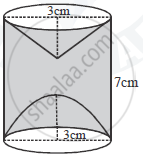
A hemispherical and a conical hole is scooped out of a.solid wooden cylinder. Find the volume of the remaining solid where the measurements are as follows:
The height of the solid cylinder is 7 cm, radius of each of hemisphere, cone and cylinder is 3 cm. Height of cone is 3 cm.
Give your answer correct to the nearest whole number.Taken`pi = 22/7`.
The radius of a sphere is 9 cm. It is melted and drawn into a wire of diameter 2 mm. Find the length of the wire in metre.
The total area of a solid metallic sphere is 1256 cm2. It is melted and recast into solid right circular cones of radius 2.5 cm and height 8 cm. Calculate: the number of cones recasted [π = 3.14]
A certain number of metallic cones, each of radius 2 cm and height 3 cm are melted and recast into a solid sphere of radius 6 cm. Find the number of cones used.
The surface area of a solid metallic sphere is 616 cm2. It is melted and recast into smaller spheres of diameter 3.5 cm. How many such spheres can be obtained?
