Advertisements
Advertisements
प्रश्न
If AB = 12 cm, BC = 16 cm and AB is perpendicular to BC, then the radius of the circle passing through the points A, B and C is ______.
पर्याय
6 cm
8 cm
10 cm
12 cm
Advertisements
उत्तर
If AB = 12 cm, BC = 16 cm and AB is perpendicular to BC, then the radius of the circle passing through the points A, B and C is 10 cm.
Explanation:
Given in the question, AB = 12 cm and BC = 16 cm.
In a circle, BC ⊥ AB. So, that means AC will be a diameter of circle.
Now, by using Pythagoras theorem in right-angled triangle ABC.
AC2 = AB2 + BC2
AC2 = (12)2 + (16)2
AC2 = 144 + 256
AC2 = 400
AC = 20 cm
So, radius of circle = `1/2 xx AC`
= `1/2 xx 20`
= 10 cm
Therefore, the radius of circle is 10 cm.
APPEARS IN
संबंधित प्रश्न
ABCD is a quadrilateral such that ∠D = 90°. A circle (O, r) touches the sides AB, BC, CD and DA at P,Q,R and If BC = 38 cm, CD = 25 cm and BP = 27 cm, find r.
In fig., O is the centre of the circle, PA and PB are tangent segments. Show that the quadrilateral AOBP is cyclic.
In the fig below, it is given that O is the centre of the circle and ∠AOC = 150°. Find
∠ABC.

In the given figure, PA and PB are tangents to the circle from an external point P. CD is another tangent touching the circle at Q. If PA = 12 cm, QC = QD = 3 cm, then find PC + PD.

Suppose you are given a circle. Describe a method by which you can find the center of this circle.
Draw a line AB = 8.4 cm. Now draw a circle with AB as diameter. Mark a point C on the circumference of the circle. Measure angle ACB.
The tangent to the circumcircle of an isosceles triangle ABC at A, in which AB = AC, is parallel to BC.
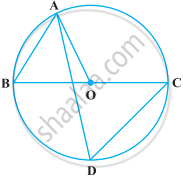
In the following figure, BC is a diameter of the circle and ∠BAO = 60º. Then ∠ADC is equal to ______.
In the following figure, O is the centre of the circle. Name a chord, which is not the diameter of the circle.

In the adjoining figure, AC is a diameter of the circle. AP = 3 cm and PB = 4 cm and QP ⊥ AB. If the area of ΔAPQ is 18 cm2, then the area of shaded portion QPBC is ______.

