Advertisements
Advertisements
प्रश्न
If AB = 12 cm, BC = 16 cm and AB is perpendicular to BC, then the radius of the circle passing through the points A, B and C is ______.
विकल्प
6 cm
8 cm
10 cm
12 cm
Advertisements
उत्तर
If AB = 12 cm, BC = 16 cm and AB is perpendicular to BC, then the radius of the circle passing through the points A, B and C is 10 cm.
Explanation:
Given in the question, AB = 12 cm and BC = 16 cm.
In a circle, BC ⊥ AB. So, that means AC will be a diameter of circle.
Now, by using Pythagoras theorem in right-angled triangle ABC.
AC2 = AB2 + BC2
AC2 = (12)2 + (16)2
AC2 = 144 + 256
AC2 = 400
AC = 20 cm
So, radius of circle = `1/2 xx AC`
= `1/2 xx 20`
= 10 cm
Therefore, the radius of circle is 10 cm.
APPEARS IN
संबंधित प्रश्न
ABC is a right triangle, right angled at B. A circle is inscribed in it. The lengths of the two sides containing the right angle are 6 cm and 8 cm. Find the radius of the incircle.
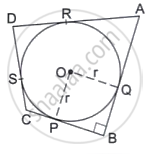
In the given figure, a circle with center O, is inscribed in a quadrilateral ABCD such that it touches the side BC, AB, AD and CD at points P, Q, R and S respectively. If AB = 29 cm, AD = 23 cm, ∠B = 90° and DS = 5 cm then find the radius of the circle.
Radius of a circle with centre O is 4 cm. If l(OP) = 4.2 cm, say where point P will lie.
Find the diameter of the circle if the length of a chord is 3.2 cm and itd distance from the centre is 1.2 cm.
In the given figure, the area enclosed between the two concentric circles is 770 cm2. If the radius of the outer circle is 21 cm, calculate the radius of the inner circle.
Find the radius of the circle
Diameter = 24 cm
If d1, d2 (d2 > d1) be the diameters of two concentric circles and c be the length of a chord of a circle which is tangent to the other circle, then ______
AB is a diameter of a circle and AC is its chord such that ∠BAC = 30°. If the tangent at C intersects AB extended at D, then BC = BD.
AB and AC are two equal chords of a circle. Prove that the bisector of the angle BAC passes through the centre of the circle.
If radius of a circle is 5 cm, then find the length of longest chord of a circle.
