Advertisements
Advertisements
प्रश्न
How many time constants will elapse before the energy stored in the capacitor reaches half of its equilibrium value in a charging RC circuit?
Advertisements
उत्तर
The equilibrium value of energy in a capacitor,
\[U = \frac{1}{2}\frac{Q^2}{C},\] where Q is the steady state charge.
Let q be the charge for which energy reaches half its equilibrium. Then,
\[\frac{1}{2}\frac{q^2}{C} = \frac{1}{2}U\]
\[ \Rightarrow \frac{1}{2}\frac{q^2}{C} = \frac{1}{2}\left( \frac{1}{2}\frac{Q^2}{C} \right)\]
\[ \Rightarrow q = \sqrt{\frac{Q^2}{2}}\]
The growth of charge in a capacitor,
\[q = Q\left( 1 - e^{- \frac{t}{RC}} \right)\]
\[ \because q = \sqrt{\frac{Q^2}{2} ,}\]
\[ \sqrt{\frac{Q^2}{2}} = Q\left( 1 - e^{- \frac{t}{RC}} \right)\]
\[ \Rightarrow \frac{Q}{\sqrt{2}} = Q\left( 1 - e^{- \frac{t}{RC}} \right)\]
\[ \Rightarrow e^{- \frac{t}{RC}} = \left( 1 - \frac{1}{\sqrt{2}} \right)\]
\[ \Rightarrow - \frac{t}{RC} = \ln\left( 1 - \frac{1}{\sqrt{2}} \right)\]
Let t = nRC
\[So, - \frac{nRC}{RC} = \ln\left( 1 - \frac{1}{\sqrt{2}} \right)\]
\[ \Rightarrow n = 1 . 23\]
APPEARS IN
संबंधित प्रश्न
A 600 pF capacitor is charged by a 200 V supply. It is then disconnected from the supply and is connected to another uncharged 600 pF capacitor. How much electrostatic energy is lost in the process?
A capacitor C1 of capacitance 1 μF and a capacitor C2 of capacitance 2 μF are separately charged by a common battery for a long time. The two capacitors are then separately discharged through equal resistors. Both the discharge circuits are connected at t = 0.
(a) The current in each of the two discharging circuits is zero at t = 0.
(b) The currents in the two discharging circuits at t = 0 are equal but not zero.
(c) The currents in the two discharging circuits at t = 0 are unequal.
(d) C1 loses 50% of its initial charge sooner than C2 loses 50% of its initial charge.
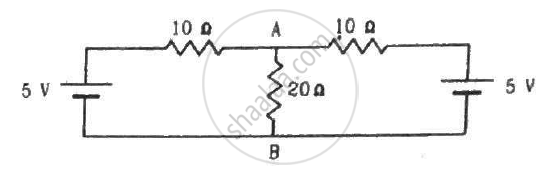
(a) Find the current in the 20 Ω resistor shown in the figure. (b) If a capacitor of capacitance 4 μF is joined between the points A and B, what would be the electrostatic energy stored in it in steady state?
A 100 μF capacitor is joined to a 24 V battery through a 1.0 MΩ resistor. Plot qualitative graphs (a) between current and time for the first 10 minutes and (b) between charge and time for the same period.
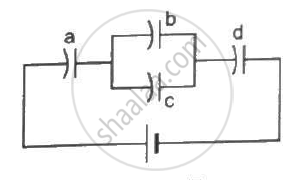
Each capacitor in figure has a capacitance of 10 µF. The emf of the battery is 100 V. Find the energy stored in each of the four capacitors.
A capacitor of capacitance 100 μF is connected across a battery of emf 6 V through a resistance of 20 kΩ for 4 s. The battery is then replaced by a thick wire. What will be the charge on the capacitor 4 s after the battery is disconnected?
A large conducting plane has a surface charge density `1.0 xx 10^-4 "Cm"^-2` . Find the electrostatic energy stored in a cubical volume of edge 1⋅0 cm in front of the plane.
If the p. d. across a capacitor is increased from 10 V to 30 V, then the energy stored with the capacitor ____________.
A parallel plate condenser is immersed in an oil of dielectric constant 2. The field between the plates is ______.
A 2µF capacitor is charge to 100 volt and then its plate are connected by a conducting wire. The heat produced is:-
Do free electrons travel to region of higher potential or lower potential?
Prove that, if an insulated, uncharged conductor is placed near a charged conductor and no other conductors are present, the uncharged body must be intermediate in potential between that of the charged body and that of infinity.
A parallel plate capacitor (A) of capacitance C is charged by a battery to voltage V. The battery is disconnected and an uncharged capacitor (B) of capacitance 2C is connected across A. Find the ratio of total electrostatic energy stored in A and B finally and that stored in A initially.
A parallel combination of two capacitors of capacities ‘C’ and ‘`C/3`’ respectively is connected across a battery of 12 volt. When both capacitors are fully charged, the charge and energy stored in them is Q1, Q2 and E1, E2 respectively. Then the ratio of (E1 − E2) to (Q1 − Q2) is ______.
What is called the energy stored in a capacitor?
What is the SI unit of energy stored in a capacitor?
If an additional small charge \(dq\) is supplied to a capacitor when its potential difference is \(V\), what is the small work done?
Using \(Q=CV\), which expression is an equivalent form of \(U=\frac{Q^2}{2C}\)?
